Roof Cleaning in Boca Raton: Why Coastal Exposure Matters
Lorem ipsum dolor sit amet, consectetur adipiscing elit. Suspendisse varius enim in eros elementum tristique. Duis cursus, mi quis viverra ornare, eros dolor interdum nulla, ut commodo diam libero vitae erat. Aenean faucibus nibh et justo cursus id rutrum lorem imperdiet. Nunc ut sem vitae risus tristique posuere.
Boca Ratonroofs can wear out sooner because salt air, high humidity, strong sun, and storm debris stay on the roof and keep causing damage.
If you live near the coast, your roof usually needs roof soft washingevery 12 to 24 months, yearly inspections, and gutter cleaning every 3 to 4 months. That matters because algae, lichen, salt film, and trapped debris can lead to rust, granule loss, stains, leaks, and up to 30% less roof life. A clean roof may also help with summer cooling by 5% to 10%.
Here’s the short answer:
Salt air wears down flashing, vents, fasteners, and metal parts
Humidity above 75% helps algae and mold grow
UV exposure dries and weakens shingles and coatings
Debris in valleys and gutters traps water and speeds up wear
High-pressure washing can damage shingles, tile, and metal
Soft washing under 500 PSI is the safer method for most roofs
Homes near the ocean orIntracoastal usually need cleaning sooner than inland homes
Quick Comparison
Roof type
Main coastal issue
Common warning signs
Safer cleaning method
Asphalt shingles
Algae, UV wear, granule loss
Black streaks, curling, granules in gutters
Soft wash
Clay/concrete tile
Lichen, moisture in pores and cracks
Dark patches, blotchy color, buildup in valleys
Soft wash
Metal
Salt corrosion, fading, chalking
Rust, dull finish, worn coating
Soft wash with roof-safe solution
You should pay close attention to dark streaks, rust spots, clogged gutters, shifted tiles, and sand-like granules after rain. The article below breaks down how coastal exposure affects each roof type, what signs to watch for, and what cleaning schedule makes sense for Boca Raton homes.
How Coastal Exposure Damages Boca Raton Roofs
Salt Air, Humidity, and Debris Speed Up Roof Wear
In Boca Raton, roofs take a beating from more than just rain and sun. Salt spray eats away at flashing, vents, fasteners, and gutters. At the same time, trapped moisture gives algae and mold room to grow. Leaves and other organic debris also pile up in valleys and under tile edges, where they hold moisture long after those short afternoon storms pass.
The result? Roof wear picks up speed, and it doesn’t look the same on every material.
How Tile, Shingle, and Metal Roofs React to Coastal Conditions
Asphalt shingles tend to lose granules, curl, and wear out faster when algae growth and UV exposure hit at the same time. Algae feeds on the limestone filler inside the shingles, which slowly thins the material, while the South Florida sun bakes the surface until it turns brittle.
Concrete and clay tile roofs usually last longer, but they’re not immune. Lichen can settle into tiny pores, and moisture that gets into microcracks can wear down the surface over time.
Metal roofs deal with a different kind of problem. Aluminum holds up better against corrosion than steel, but once protective coatings on steel get scratched, salt air can start breaking them down.
Leave that buildup sitting there, and small surface issues can turn into leaks and early roof wear.
What Happens When Coastal Buildup Goes Unaddressed
Once debris, algae, and moisture stay on the roof, the damage doesn’t stop at the surface. Staining can turn into lifted tiles, hidden leaks, and rusted flashing. What looks minor from the ground can become trapped moisture underneath.
Algae buildup can keep the roof deck damp enough to rot the wood below. Storm winds can also lift tiles and expose the underlayment, which opens the door to water intrusion.
If buildup is left alone, a roof’s service life can drop by up to 30%. And when that happens, repair bills can climb in a hurry.
sbb-itb-20350f7
The SAFEST Way to SOFT WASH a Roof (full tutorial)
Signs Your Roof Needs Professional Cleaning
When coastal buildup starts to show up, the clues are usually pretty easy to spot.
Visible Growth, Stains, and Surface Changes
Black streaks on asphalt shingles usually mean algae is growing on the roof.
Tile roofs show wear a bit differently. Reddish clay tiles can start to look blotchy or washed out, and concrete tiles may develop gray or black patches. On metal roofs, salt air and UV exposure can lead to a dull finish, fading, or chalking. In many cases, these changes show up first on north-facing slopes and shaded valleys, where moisture tends to stick around.
Rust, Granule Loss, and Gutter Warning Signs
Some of the strongest warning signs show up in the gutters. If you see sand-like granules after rain, your shingles are shedding the UV-protective layer that helps keep them from drying out and cracking. Orange or brown rust on flashing, vents, or fasteners is another clear sign. It often means salt air has started to wear down those metal parts and their seals.
Gutters that clog again and again after storms can also point to a roof problem. In many cases, debris is piling up in roof valleys and trapping moisture along the roof edge.
When Time Without Cleaning Is a Warning Sign
In Boca Raton, time alone can be a warning sign. On tile roofs, streaks and lichen often show up within 2 years if the roof isn't cleaned. By year 3 or 4, black staining is common. Homes near the Intracoastal or the ocean often see buildup sooner because salt exposure is heavier.
Here are the main signs to look for:
Black streaks or green patches - active algae or lichen
Granules in gutters - shingle wear
Rust on flashing or vents - salt corrosion
Repeated gutter clogs - debris trapping moisture
If your roof hasn't been professionally cleaned in 12 to 18 months, it's smart to have it checked soon, especially if the property is near the Intracoastal or the ocean.
These signs usually point to the need for gentle professional cleaning, not harsh pressure washing.
Safe Cleaning Methods for South Florida Roofs
Once stains, rust spots, or granule loss show up, the cleaning method matters just as much as the cleaning itself. For South Florida roofs, soft washing is the safer pick. High pressure is not.
Why High-Pressure Roof Washing Can Cause Damage
High-pressure washers can exceed 3,000 PSI. That’s more than enough force to knock protective granules off asphalt shingles, crack the edges of clay tiles, dent metal panels, and push water under the underlayment. When that happens, the roof decking can get soaked, and rot can start from the inside out.
In Boca Raton, this risk is even higher. Coastal roofs often look tougher than they are, but years of UV radiation and salt exposure can leave roofing materials more fragile and easier to damage. One bad pass with a pressure washer can leave permanent damage behind.
There’s also the warranty side of this. Many shingle manufacturers base their maintenance guidance on periodic low-pressure cleaning, and high-pressure washing can void coverage.
Why Soft Washing Works Better for Tile, Shingle, and Metal Roofs
Soft washing leans on chemistry instead of brute force. A professional-grade mix - usually water, sodium hypochlorite at a 1% to 3% concentration, and surfactants - is applied at under 500 PSI. It then sits on the surface for 5 to 10 minutes, killing mold, mildew, lichen, and algae at the root instead of only rinsing off what you can see.
Surfactants do a lot of the heavy lifting. They lower surface tension, which helps the cleaning mix stay on curved tiles and sloped shingles instead of sliding right off. On metal roofs, the solution needs to be safe for factory coatings and fasteners. On asphalt shingles, soft washing helps keep the granules and fillers in place - the parts that shield shingles from UV damage.
A professional soft wash can keep a South Florida roof clean for 12 to 24 months.
How Palm Shine Pros Supports Coastal Roof Maintenance
Before any cleaning solution touches the roof, nearby plants and soil should be thoroughly pre-soaked with fresh water, and downspouts should be covered to contain runoff.
Palm Shine Pros supports coastal roof care with roof-safe soft washing and gutter cleaning. Soft washing cleans at low pressure, while high-pressure washing can strip materials, force in water, and speed up wear.
That approach makes the most sense when it’s part of a regular roof maintenance schedule.
Routine Maintenance That Lowers Long-Term Roof Costs
Coastal vs. Inland Roof Maintenance Schedule for Boca Raton Homes
In Boca Raton, routine cleaning helps stop salt, algae, and debris from turning into roof repairs. Once stains or rust show up, the next step is simple: keep that buildup from coming back.
Recommended Cleaning and Inspection Intervals for Coastal Properties
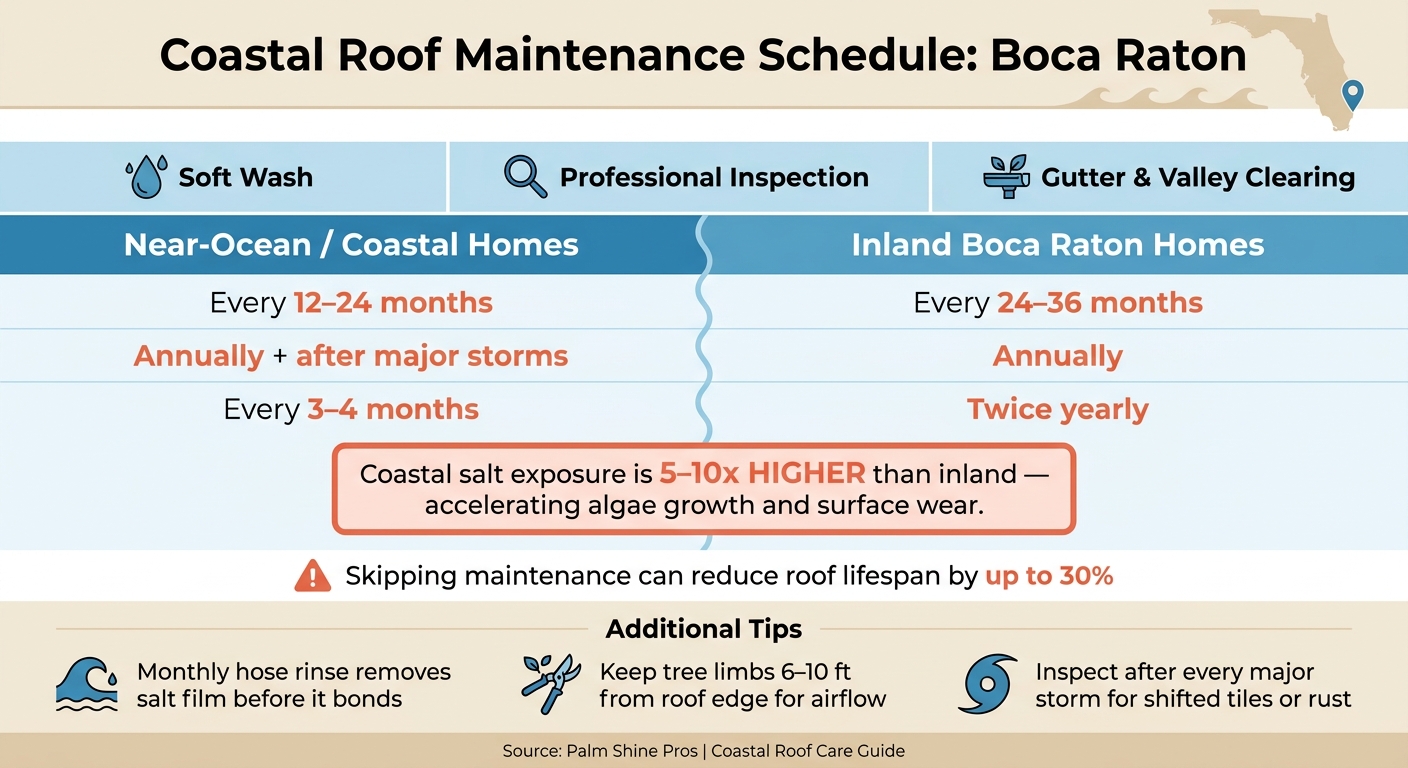
How often a roof needs care depends a lot on location. Properties near the coast deal with much more salt exposure - 5 to 10 times higher than inland. That extra salt helps algae stick faster and wears surfaces down sooner, so coastal roofs usually need more frequent cleaning.
Roofs should be inspected once a year, ideally before hurricane season begins on June 1. A simple schedule looks like this:
Maintenance Task
Near-Ocean / Coastal
Inland Boca Raton
Soft Wash
Every 12–24 months
Every 24–36 months
Professional Inspection
Annually, plus after major storms
Annually
Gutter & Valley Clearing
Every 3–4 months
Twice yearly
For coastal homes, it also helps to rinse the roof monthly and keep overhanging limbs 6 to 10 feet back from the roof edge.
Keeping up with this schedule makes each cleaning lighter, safer, and less expensive. It also lowers the odds of damage to landscaping and roof coatings during maintenance.
Simple Upkeep Steps Between Professional Cleanings
Between cleanings, a few simple habits can slow the return of salt, debris, and algae. After storms, clear roof valleys with a soft broom or leaf blower. Skip metal tools - they can scratch tile or strip granules off shingles. On coastal homes, a monthly hose rinse helps remove salt film before it bonds to the surface. That matters because salt film, trapped moisture, and organic buildup all wear a roof down faster.
Trim tree limbs so they stay 6 to 10 feet away from the roof edge. More sun and airflow help slow algae growth and cut down on leaf litter. Gutters matter too. When they clog, water can spill over the roof edge and rot fascia boards and the underlayment below.
A quick visual check from the ground after storms is time well spent. Watch for:
Dark streaks
Shifted tiles
Rusted flashing
Granules collecting in gutters
Those are early signs that the roof may need attention.
Conclusion: How Coastal Roof Cleaning Protects Your Property and Your Budget
Boca Raton’s salt air, year-round humidity, and storm debris are hard on roofs. Left alone, Gloeocapsa magma algae can cut a roof’s service life by up to 30%. On a part of the home that can cost many thousands of dollars to repair or replace, that’s no small hit.
Spotting early warning signs - dark streaks, rust spots, or granule loss - before they turn into deeper structural problems can help keep costs under control. The right maintenance schedule protects the roof you already have and helps put off bigger repair bills.
How close to the coast is considered high exposure?
High exposure usually means near the coast - within a few miles of the ocean or the Intracoastal, where salt in the air tends to affect roofs more.
A waterfront home faces the most exposure. Move about 5 miles inland, and roof conditions can look quite different.
Can roof cleaning help lower energy bills?
Yes. Grime, algae, and mold can soak up heat instead of reflecting sunlight. That can make your home hotter and force your air conditioner to work harder.
Professional cleaning clears away that buildup so your roof reflects sunlight better. The result: a cooler home and, in some cases, lower cooling costs.
Should I clean my roof after every major storm?
Not necessarily. You don’t need a full roof cleaning after every storm, but a professional inspection should be high on your list.
You can gently clear away leaves, twigs, and small branches with a soft broom or leaf blower. That helps stop moisture from sitting on the roof and causing trouble over time.
After storm season, schedule a professional roof inspection to look for hidden damage, missing shingles, or cracked tiles.
.avif)

.avif)