How Long a Soft-Washed Roof Stays Clean in South Florida
Lorem ipsum dolor sit amet, consectetur adipiscing elit. Suspendisse varius enim in eros elementum tristique. Duis cursus, mi quis viverra ornare, eros dolor interdum nulla, ut commodo diam libero vitae erat. Aenean faucibus nibh et justo cursus id rutrum lorem imperdiet. Nunc ut sem vitae risus tristique posuere.
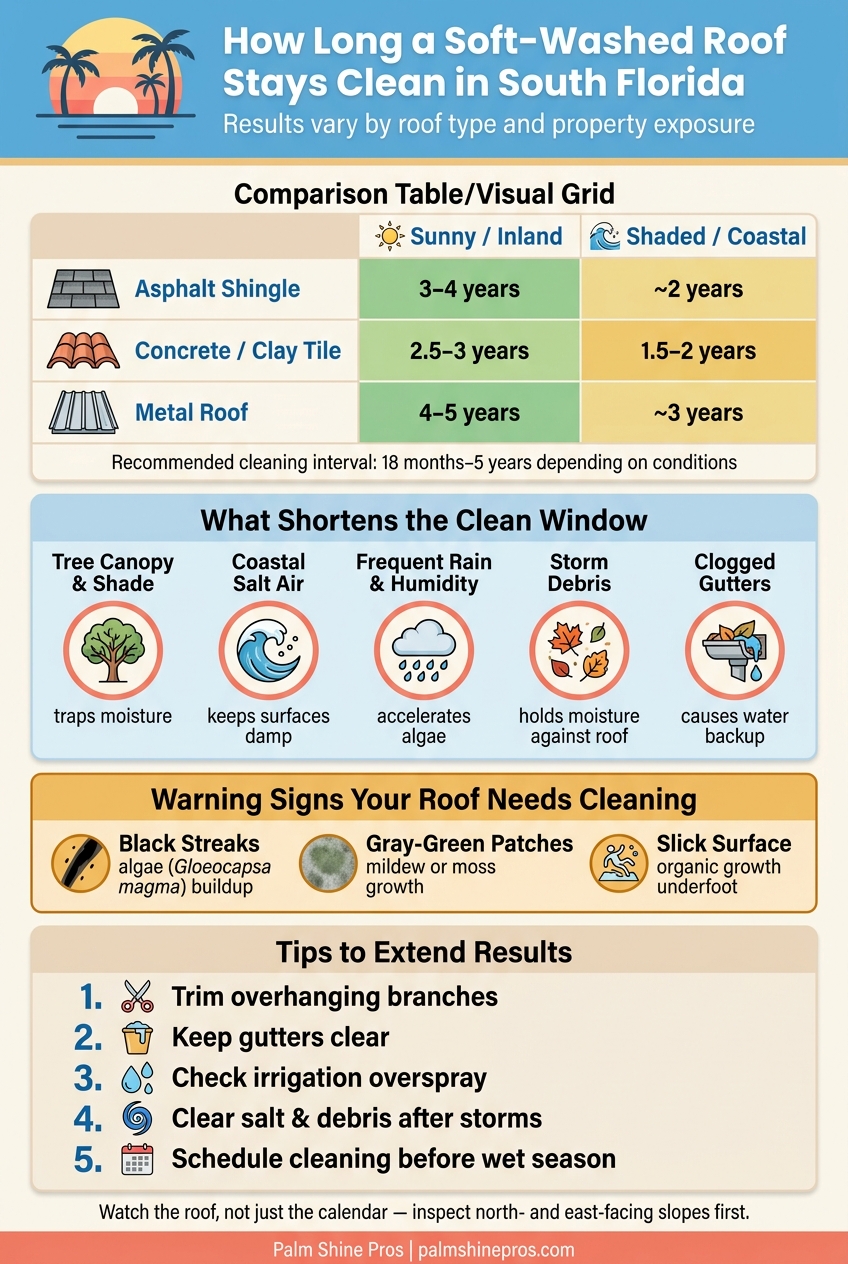
In South Florida, asoft-washed roofusually stays clean for 18 months to 5 years, with most homes landing around 2 to 4 years.
Your timeline depends on two things: roof type and exposure. Asphalt shingles often show black streaks sooner, tile roofs can hold moisture and stain faster, and metal roofs often stay clean the longest. Shade, tree cover, salt air, clogged gutters, and storm debris can all cut that clean window short.
Here’s the short answer:
Asphalt shingles: about 2 to 4 years
Concrete or clay tile: about 18 months to 3 years
Metal roofs: about 3 to 5 years
Sunny inland homes: usually stay clean longer
Shaded or coastal homes: often need cleaning sooner
Watch the roof, not just the calendar. If you see black streaks, gray-green patches, or a slick surface, the roof is likely due again.
Roof Type
Sunny / Inland
Shaded / Coastal
Usual Cleaning Range
Asphalt Shingle
3–4 years
About 2 years
24–48 months
Concrete / Clay Tile
2.5–3 years
1.5–2 years
18–36 months
Metal Roof
4–5 years
About 3 years
3–5 years
A few simple steps can help the clean look last longer: trim branches, keep gutters clear, check irrigation overspray, and clear salt and debris after storms. The article below breaks down how each factor affects your roof in South Florida.
How Long a Soft-Washed Roof Stays Clean in South Florida by Roof Type & Exposure
How long a soft-washed roof stays clean by roof type and property conditions
How long a roof keeps that clean look comes down to two things: roof material and exposure. The material sets the rough time range. Then shade, airflow, and coastal moisture push that number up or down.
Asphalt shingles, tile, and metal roofs stay clean for different lengths of time
Asphalt shingles usually show staining sooner than other roof types. That’s because Gloeocapsa magma - the bacteria behind those black streaks - feeds on the limestone filler in the shingles. On a sunny inland property, asphalt shingles can stay visibly clean for 3 to 4 years. In shaded spots or near the coast, that can drop to about 2 years.
Concrete and clay tile roofs have a different issue. They’re porous, so they hold moisture longer than shingles or metal. More moisture means a shorter clean window. On inland properties with good sun exposure, tile roofs may stay clean for 2.5 to 3 years. On shaded or coastal homes, cleaning may be needed in about 18 months.
Metal roofs - including standing seam and 5V-crimp styles common in South Florida - usually hold a clean appearance longer. They shed water and organic buildup more easily than asphalt or tile. In a sunny, open setting, a metal roof can stay clean for 4 to 5 years.
Sunny inland roofs tend to stay clean longer than shaded or coastal roofs
Where the roof sits matters just as much as what it’s made of. Roofs in sunny, open areas dry out faster, which slows algae and mildew growth. Shaded roofs stay damp longer, and that damp surface gives organic growth room to spread. North- and east-facing slopes often stain first because they get less direct sun and hang onto humidity longer. Near the coast, there’s another factor: salt in the air holds moisture, so roofs can stay damp even when it hasn’t rained.
Use the ranges below as a starting point. Then trim them down if the roof has heavy shade, overhanging trees, or coastal exposure.
Roof Type
Sunny / Inland
Shaded / Coastal
Recommended Cleaning Interval
Asphalt Shingle
3–4 years
About 2 years
Every 24–48 months
Concrete / Clay Tile
2.5–3 years
1.5–2 years
Every 18–36 months
Metal Roof
4–5 years
About 3 years
Every 3–5 years
In most cases, exposure explains the gap between the low and high end of each range. If you notice dark gutter streaks or gray-green patches on north- or east-facing slopes, that’s often a sign the roof is due for another cleaning.
sbb-itb-20350f7
What shortens the clean window in South Florida
In South Florida, those roof-cleaning timelines often get cut short for one simple reason: the roof stays damp. And when a surface doesn't dry well, algae, mildew, and staining come back faster.
Humidity, heat, and frequent rain speed up algae and mildew
South Florida's heat and year-round humidity keep roofs damp for long stretches, which speeds up algae and mildew regrowth. Add frequent rain to the mix, and the surface stays wet even longer. Once the protective effect from a soft wash starts to fade, that growth can come back fast.
Tree canopy, roof orientation, and debris create damp spots that stain sooner
Climate is only part of the story. The way a property is set up also plays a big role.
Roof areas under a tree canopy stay wet longer than sections that get direct sun. Overhanging branches also drop leaves, palm debris, and tannins, which hold moisture against the roof surface. North- and east-facing slopes often stain sooner too, because they get less direct sunlight and tend to hold humidity longer after rain. On top of that, dense landscaping around the home can block airflow, so the roof takes more time to dry.
Coastal exposure and storms can make roofs look dirty faster
Homes near the ocean have another problem: salt spray. It can keep roof surfaces damp and make them look dirty faster. Wind direction matters as well. East and southeast breezes often coat the more exposed sides of a home with salt and airborne debris faster than the sheltered sides.
Storms can make the effect even worse by throwing more salt and debris onto the roof. If you want a closer look at that, see this breakdown of storm impacts.
What helps soft-wash results last longer
Solution strength and application quality affect how long results hold
The first thing that matters is the wash itself. Solution strength, dwell time, and coverage all shape how long the results last. A south-facing roof slope often needs more time than a shaded section on that same roof. Sun exposure changes how the treatment behaves, so even on one house, conditions can vary.
Application method matters too. Applying the solution from the ridge down to the eaves in even passes helps cover the roof fully without soaking areas around flashings, roof penetrations, and attic vents. A neutralizing rinse also helps protect roof materials after treatment.
After the wash, upkeep plays a big part in how long the roof stays clean.
Simple upkeep steps that extend time between roof cleanings
What happens between cleanings matters just as much as the cleaning itself. Trimming overhanging branches is one of the best steps a homeowner can take. It cuts down shade and helps air move around the roof. Keeping gutters clear matters too.
It also helps to check irrigation overspray. Well water can leave rust stains and streaks.
After a storm, clear salt and debris fast. Salt is hygroscopic - it pulls moisture from the air - so when a salt film stays on the surface, it stays damp too. That creates the kind of damp, sticky surface where mold and algae come back fast.
Match your cleaning schedule to your property's exposure
The best cleaning interval depends more on exposure than on the calendar. A shaded roof with heavy vegetation nearby or a roof close to the coast will usually need cleaning sooner than a sunny inland roof.
If you wait until the roof looks dirty, you've probably waited too long. Once dark streaks show up on north-facing sections or the surface starts to feel slippery, organic growth is already well established.
A smart move is to schedule cleaning before the wet season. That way, the roof is treated just before humidity and rain ramp up, which is when algae regrowth tends to return the fastest.
Conclusion: The right schedule and upkeep keep roofs cleaner for longer
Put it all together, and the answer has a pretty wide range. Most soft-washed roofs in South Florida stay clean for 18 months to 5 years, depending on the roofing material and how much sun, shade, salt, and moisture the property gets. In South Florida, that window can shrink fast on shaded homes or places near the coast.
Once you factor in exposure, the schedule gets more specific. Homes closest to the coast deal with the harshest conditions. Inland properties with good sun exposure, clear gutters, and trimmed tree canopies can sometimes go 3–5 years between cleanings.
The big thing to watch is exposure, not the date on the calendar. North- and east-facing roof sections usually stain first, and once black streaks show up, the roof is already overdue. If you need help staying ahead of that cycle, Palm Shine Pros offers power and soft washing services.
FAQs
How do I know my roof is due again?
Watch for visible organic growth, especially black streaks or staining, which is often caused by Gloeocapsa Magma.
A soft-washed roof usually stays clean for 12 to 18 months. As you get close to that range, check for dark patches or fuzzy buildup. If the growth comes back sooner, local conditions or recent weather may be part of the reason.
Which roof areas get dirty first?
Areas that stay damp or get less direct sunlight usually get dirty first. In South Florida, that often means north-facing roof slopes and sections shaded by overhanging trees.
Because these areas dry more slowly, they give algae, mold, and mildew more time to build up.
When should I schedule roof cleaning in South Florida?
In South Florida, most homes do well with professional soft washing every 6 to 12 months.
That said, the right schedule depends on the setting around your home. Heavy tree cover, high humidity, and coastal exposure can speed up organic growth. In those cases, some properties may need cleaning every 3 to 6 months.
If you notice streaks or visible buildup, it’s time to schedule service.
.avif)

.avif)