Window Cleaning in Coral Gables: Why Results Look Different
Lorem ipsum dolor sit amet, consectetur adipiscing elit. Suspendisse varius enim in eros elementum tristique. Duis cursus, mi quis viverra ornare, eros dolor interdum nulla, ut commodo diam libero vitae erat. Aenean faucibus nibh et justo cursus id rutrum lorem imperdiet. Nunc ut sem vitae risus tristique posuere.
If yourCoral Gableswindows look dirty again in 7–14 days, the problem is usually not the cleaning. It is the iron, the sprinkler spray, the old hardware, or the masonry around the glass.
Your windows can look different from other Miami homes because Coral Gables homes often have iron grilles, casement or jalousie windows, stucco and terra cotta surrounds, and more irrigation exposure. That mix leads to three main issues: rust halos, hard-water mineral spots, and grit packed into tracks and moving parts. In many cases, standard glass cleaner only removes surface dirt, not the bonded residue that keeps coming back.
Here’s the short answer:
Rust near frame edges often comes from oxidizing ironwork
Cloudy white or gray spots usually come from sprinkler overspray or mineral runoff
Streaks that return after opening a window often start in dirty tracks or hardware
Garden-facing lower windows usually get dirty much faster than protected upper panes
Clean results last about 2–3 months on protected glass, but sometimes only 1–2 weeks on windows hit by sprinklers
What matters most is the source of the stain. If the source stays in place, the glass can spot up again soon after cleaning.
Quick Comparison
Issue
What you see
What causes it
How long results may last
Iron oxidation
Orange-brown halos or streaks
Rust from grilles, guards, or balcony metal
A few weeks on exposed areas
Hard-water overspray
White haze, rings, rough spots
Sprinklers and mineral-heavy water
7–14 days on spray-hit glass
Track and hardware buildup
Edge streaks after opening
Grit in jalousie or casement parts
Until tracks are cleaned out
Mineral runoff from surrounds
Haze near window borders
Stucco, terra cotta, and masonry runoff
Varies by rain and irrigation exposure
That is why window cleaning in Coral Gables is not just about the glass. Your result depends on the frame, the hardware, the surrounding material, and how much water hits the window after the job is done.
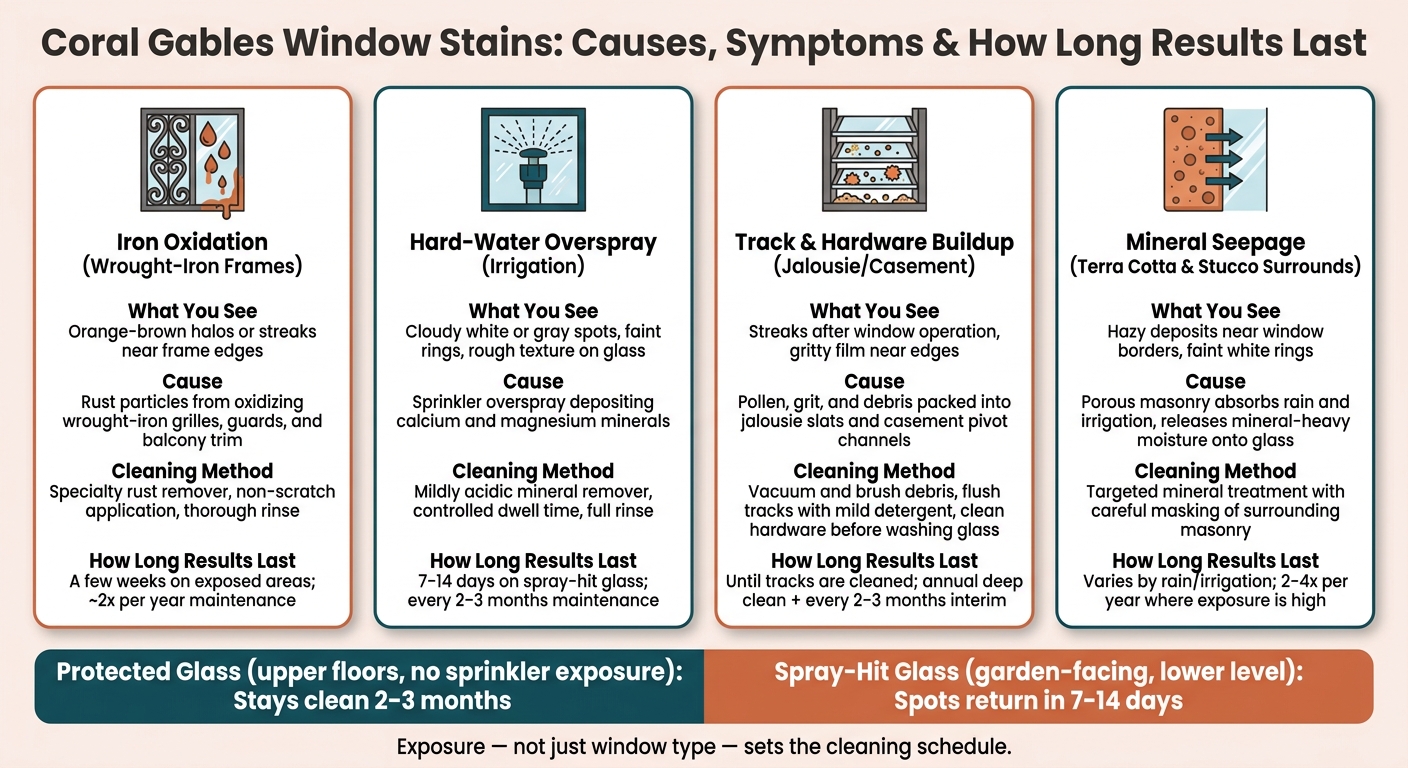
Coral Gables Window Stains: Causes, Symptoms & How Long Results Last
What makes Coral Gables windows harder to clean
Coral Gables windows usually get dirty in three main ways: rust from ironwork, grit packed into older hardware, and mineral stains from overspray and porous surrounds. And the problem isn't just the glass. The frame, track, and surround all play a part.
Wrought-iron frames leave rust halos on glass
Decorative wrought-iron grilles, window guards, and balcony trim are a big part of many Mediterranean Revival homes. In South Florida's warm, humid air, that iron starts to oxidize. Once that happens, the rust doesn't stay put.
Rust particles and dissolved iron compounds move with water along the frame-glass joint. When the water dries, it leaves behind orange-brown halos, teardrop streaks, and a light rust haze near the edge of the pane.
These marks don't come off with standard glass cleaner because they're bonded residue sitting on the glass. In some cases, repeated corrosion can leave faint etching in the surface, which creates a ghost outline even after the window has been cleaned. The salt-air corrosion process helps explain why this shows up so often in coastal Florida. On multi-story facades, rust ghosting often forms below Juliet balconies or window guards. On ground-floor windows near landscaping, irrigation can keep the iron wet more often, so the staining tends to be heavier and come back sooner.
That is why iron stains need a different treatment than mineral spots or track debris.
Casement and jalousie windows trap debris in tracks and hardware
Pre-1970s Coral Gables homes often have casement windows and jalousie systems with multiple glass louvers linked by pivot arms. These designs have many more exposed moving parts and channels than modern window styles.
Those channels collect pollen, leaf bits, dust, and grit. Rain and irrigation overspray mix with that buildup inside tracks, hinge pockets, and crank housings. The result is a gritty film that clings to metal and gasket surfaces. Then, when the window opens or closes, the hardware pulls that residue across the glass edges and leaves fresh streaks right after cleaning.
Jalousie louvers are especially prone to this. Each louver moves close to hardware arms that can be coated with fine grit, so simply operating the window can dirty the glass all over again.
Terra cotta surrounds and irrigation overspray cause mineral staining on glass
Many Coral Gables window openings are bordered by porous terra cotta tiles, stucco moldings, and decorative masonry. These materials soak up rainwater and irrigation mist, then release mineral-heavy moisture that moves toward the glass through seepage and runoff. As that water dries on the pane, it leaves bonded mineral deposits that show up as cloudy white or gray spots, faint rings, or a light haze.
Garden-facing windows usually get hit the hardest. Automatic sprinkler systems in Coral Gables can spray lower panes directly, and the hard-water spots often show up in arcs and fan shapes that match the sprinkler pattern. Because these deposits are crystalline and bonded, they resist standard glass cleaner and may feel slightly rough under a fingernail. The porous surround feeds the deposit. The glass is where you see the result.
Because each problem binds differently, each one needs a different cleaning method.
sbb-itb-20350f7
Why these problems call for different cleaning methods
Once you know what kind of stain you're looking at, the cleaning plan shifts. Soap and a squeegee are fine for light film and fingerprints. But rust halos, bonded mineral deposits, and packed track debris are a different beast. Each one needs its own fix.
Rust, mineral deposits, and hardware buildup each need a separate treatment
Rust halos usually need a specialty rust remover, a non-scratch pad, some dwell time, and a full rinse. Plain detergent doesn't react with iron oxide, so it tends to leave most of the stain behind.
Hard-water mineral deposits are bonded scale sitting on the glass. Soap won't do much here either. These stains usually respond to mildly acidic cleaners or hard-water removers.
Track buildup is more of a physical cleanup job. Packed debris needs to be vacuumed or brushed out first. After that, the tracks should be flushed with a mild detergent solution and scrubbed with soft detail brushes before the glass is cleaned. If you skip that step, the grime in the track can end up right back on the glass the next time the window opens or closes.
One cleaner won't fix all three. Use the wrong method, and the stain tends to come back fast. Leave the source in place, and it comes back even faster. That's why each issue has to be handled on its own.
Surrounding materials limit pressure and chemical choices
Stucco, terra cotta, painted trim, and iron frames don't handle high pressure, strong acids, strong alkalines, or abrasive tools well. Pros usually stick to low pressure or hand cleaning near window assemblies and decorative details. In many cases, they skip pressure altogether on intricate sections and use hand tools with small, controlled rinses instead.
Chemicals that cut through rust or mineral scale fast can also strip paint, discolor terra cotta, or speed up corrosion on exposed metal if they're not controlled well. The usual approach is simple:
Pre-wet nearby masonry
Test in a hidden spot
Keep the treatment contained
Rinse it clean
Razor blades and abrasive pads are also avoided on glass, especially on coated or impact glass, because they can leave micro-scratches that permanently dull the surface.
Cloudy white or gray spots, faint rings, rough texture on glass
Mildly acidic mineral remover, controlled dwell time, gentle agitation, full rinse
Every 2–3 months for garden-facing windows
Jalousie/casement track and hardware buildup
Streaks after window operation, gritty film near edges
Vacuum and brush debris, flush tracks with mild detergent, clean the tracks and hardware before washing glass
Annual deep clean; lighter interim cleanings every 2–3 months
Terra cotta surround mineral seepage
Hazy deposits near window borders, faint white rings
Targeted mineral treatment with careful masking of surrounding masonry
2–4 times per year where irrigation exposure is high
How long clean windows last in Coral Gables
Once the right cleaning method is in place, exposure is what decides how long the glass stays clean. In Coral Gables, that matters more than the wash itself. A pane that gets hit by sprinklers can look spotted again much sooner than one that stays dry.
Put simply: exposure, not just window type, sets the cleaning schedule.
On protected elevations - upper-story glass, front façades set back from irrigation, and windows above the sprinkler arc - professionally cleaned windows can keep their clear look for 2–3 months. The haze tends to come back slowly. But on garden-facing, lower-level windows that sit within range of spray heads, that same fresh-clean look can fade in just 7–14 days. Sprinkler water lands on the glass, dries under the sun, and leaves behind a ring of calcium and magnesium. When that happens day after day, the spots return fast.
Garden-facing and iron-framed windows dirty the fastest
Windows near active sprinkler zones, thick hedges, and decorative ironwork usually get dirty first.
Iron-framed windows and balconies deal with another issue on top of irrigation. In South Florida’s warm, humid air, wrought iron oxidizes and sheds tiny rust particles over time. Rain or heavy dew then washes those particles onto the glass below. That’s why a casement window with a decorative iron grille may show faint orange-brown halos again within a few weeks of a deep cleaning, while a plain-framed window on the same wall stays cleaner much longer. If the iron isn’t treated, the staining keeps coming back.
Window style also plays a part. Jalousie and casement windows, which are common in older Coral Gables homes, have more hardware, more joints, and more places for moisture and debris to settle. Even after a deep clean, residue tucked into the hardware can work its way back onto the glass as the window opens and closes.
Reducing overspray and managing corrosion extends results
The best fix is often simple: move sprinkler spray away from the glass. Run each irrigation zone and watch which windows get hit. Rotating or shifting the heads so the spray clears the window line - even by a few inches - can stretch the clean look from 7–10 days to 3–4 weeks on the same elevation.
For homes with decorative ironwork, catching rust early helps a lot. Lightly wiping down iron grilles and railings every few weeks, then applying a rust-inhibiting coating once a year, cuts down on the corrosion that ends up on nearby glass.
It also helps to match service frequency to the season. More frequent visits during the high-exposure months from late spring through early fall, with slightly more spacing during the drier winter season, can help each cleaning hold up longer in day-to-day use.
When the same stains come back this quickly, basic glass cleaning isn’t enough.
When DIY stops working and professional window cleaning makes sense
DIY glass cleaning does not remove bonded stains or deep track debris
When the same spots keep coming back, routine cleaning has hit its limit. At that point, the issue has moved past DIY.
Standard glass cleaners can take care of loose dirt, fingerprints, and fresh water spots. But they don't fix rust residue from wrought-iron frames, mineral scale bonded to the glass, or debris packed into jalousie slats and casement pivot channels. If the haze looks the same wet or dry, it's bonded.
Older casement and jalousie systems are tough to clean with household tools because their narrow channels and pivot points hold onto dirt and debris. professional window cleaning benefits explains why. The problem usually comes down to access and method, not effort alone.
DIY versus professional capabilities comparison table
That gap shows up most clearly in how each issue is handled.
Task
DIY Limitation
Professional Method
Basic glass cleaning
Removes loose dust and fingerprints only
Wash plus targeted spot treatment
Hard-water removal
Vinegar helps light spots only
Mineral-specific treatments, controlled time on the glass, and careful rinse
Rust halo treatment
Household cleaners cannot remove rust residue or iron transfer
Specialized stain treatment matched to glass and frame material
Track and hardware cleaning
Surface wiping misses hidden channels
Access to joints, pivot points, and channels with appropriate tools
Conclusion: Coral Gables windows need architecture-specific care
Coral Gables windows need architecture-specific care because iron, tracks, mineral runoff, and overspray all shape the final result. Use the wrong method, and bonded stains can stay in place, debris can get pushed deeper into older hardware, and decorative masonry or oxidized metal finishes next to the glass can get damaged.
Match the method to the problem, and the difference shows right away. Windows look cleaner, and they tend to stay that way longer.
That's why method matters as much as appearance.
If spots keep returning after household cleaning, the issue calls for targeted treatment. Palm Shine Pros offers window washing for Coral Gables homes with older window systems and decorative ironwork.
FAQs
Can hard-water spots permanently damage glass?
Yes. Hard-water spots may look like simple surface residue at first, but over time, those minerals can etch the glass.
In Coral Gables, irrigation deposits and minerals that leach from terra cotta can stick to nearby windows. Once etching sets in, standard cleaning can’t fully bring back the glass’s original clarity.
Should sprinkler heads be adjusted to protect windows?
Yes. Adjust sprinkler heads, or shut them off for a bit, so water doesn’t spray right onto windows and frames. When sprinklers hit those areas over and over, they can leave more grime behind and add extra moisture around openings and tracks.
If you’re doing any cleaning or protective step that needs dry conditions, turn sprinklers off at least 24 hours before and keep them off for 48 hours after.
How do I tell rust stains from mineral stains?
Check the color and where the stain begins. Rust stains usually show up as reddish-orange marks and often come from wrought-iron frames that are oxidizing.
Mineral stains tend to look white, chalky, or hazy. They usually come from hard water or from minerals leaching out of terra cotta surrounds and onto the glass.
.avif)

.avif)