Gutter Cleaning in Pompano Beach: What the Rainy Season Demands
Lorem ipsum dolor sit amet, consectetur adipiscing elit. Suspendisse varius enim in eros elementum tristique. Duis cursus, mi quis viverra ornare, eros dolor interdum nulla, ut commodo diam libero vitae erat. Aenean faucibus nibh et justo cursus id rutrum lorem imperdiet. Nunc ut sem vitae risus tristique posuere.
InPompano Beach, gutters often need cleaning before, during, and after rainy season - not just twice a year.
From May 15 to October 15, South Florida gets about 60% to 70% of its yearly rain, and Pompano Beach can see about 33.4 inches during that stretch. Add live oak leaves, ficus litter, and queen palm debris, and even a partly filled gutter can overflow during a hard afternoon storm.
Here’s the short answer for most homes:
Late April to May: clean gutters before daily storms start
June to August: check for clogs, overflow, and packed debris
September to October: clear late-season buildup after peak rain
Heavy tree cover: plan for 3 to 4 cleanings per year
Light tree cover:2 cleanings per year may be enough
What drives the schedule?
Frequent storm bursts: heavy rain can hit in 30 to 60 minutes
Wet debris packs down fast: small clogs can choke water flow
Tree canopy matters: oaks, ficus, and palms clog gutters in different ways
Pompano Beach vs. Miami: both get wet-season rain, but Broward homes often deal with faster gutter reload from canopy and storm pattern
Quick Comparison
Factor
Pompano Beach
Miami
Rain pattern
Short, hard afternoon storms; coastal squalls
Wet season too, but more neighborhood-to-neighborhood variation
Main debris
Live oak, ficus, queen palm
Mixed canopy
Gutter issue
Debris mats and plugs outlets fast
Depends more on local tree cover
Common cleaning pace
3–4 times/year on canopy-heavy lots
2 times/year baseline, more if trees are dense
This article breaks down the storm pattern, the tree debris mix, and the cleaning schedule that fits Pompano Beach homes.
How Broward's Rainy Season Fills Gutters in Pompano Beach
In Broward County, rainy season doesn't usually bring all-day rain. It comes in short bursts that hit hard, then come back again. That pattern matters. About 43 inches of rain falls within just five months, which puts a lot of pressure on gutters in a short stretch of the year. And when tropical systems move up the coast, that same cycle of leaves, grit, and runoff can keep repeating for days instead of just one stormy afternoon.
Afternoon Storms and Coastal Squalls
South Florida's wet season tends to follow the same daily rhythm. Mornings are often clear. Heat builds through the middle of the day. Then, by early afternoon, sea breezes from the Atlantic and Gulf collide over the peninsula and set off storms, usually between 2 and 6 p.m.
These storms are short, but they can dump a lot of water fast. Typical rainfall intensity runs about 1–3 inches in 30–60 minutes. In Broward County, storms have also been recorded at 3–4 inches per hour, with isolated spots topping 5 inches in a single event.
Here's what that means at the gutter line: wind loosens debris first, then heavy rain pushes it toward downspout openings and elbows. That's why clogs often show up at the downspout mouth or bend, even when the rest of the gutter doesn't look that bad.
How Debris Changes Between One Storm and the Next
When storms keep coming, gutters often stay wet between rain events. And wet debris is a different animal than dry yard litter. Leaves, roof grit, and fine organic matter start to mix together and press into a thick, muddy layer that sticks to gutter bottoms and seams.
That buildup doesn't need to fill the whole gutter to cause trouble. Clogged gutters can lose up to 90% of their water-handling capacity, so a gutter that looks only partly dirty can still stop working when a hard storm moves through.
When Clogged Gutters Start Affecting the Exterior Before Storm Season Peaks
Most of the time, the warning signs show up before the gutter looks fully blocked. You might see:
Water spilling over the roofline during rain
Streaks or stains on fascia boards and siding
Damp spots below gutter runs
Pooling water near walkways or the foundation
Those signs can come from a partial clog, not just a gutter packed solid with debris. Once material gets compacted, drainage slows down enough that heavy rain can force water over the edge.
For the exterior damage clogged gutters can trigger, see our flood-proofing guide. Catch buildup early before overflow stains fascia, siding, and walkways.
sbb-itb-20350f7
The Pompano Beach Tree Canopy and How It Affects Gutter Cleaning Frequency
In Pompano Beach, gutter buildup depends just as much on tree cover as it does on rain. Once storms start soaking the canopy, the kind of debris sitting along the roof edge matters just as much as how hard it rains.
Live Oak, Ficus, and Queen Palm Debris Types
Live oaks drop fine leaves, spring catkins, and acorns. When that material gets wet, it packs down into a felt-like layer. Ficus trees shed small, uniform leaves at a steady rate, which adds a thin layer to gutters after nearly every storm. Queen palms are a different story. They drop large fronds, heavy seed clusters, and fibrous sheath strands, and most of that tends to fall during storms instead of in the quieter days between them.
Why Some Debris Mats and Other Debris Span the Gutter Run
This mix creates a clog in layers. Live oak debris settles first and forms the base. Ficus leaves slip into the open spaces. Then palm fronds stretch across the gutter channel and act like a net, trapping even more material with each storm.
It’s a bit like building a blockage from the bottom up. One layer holds the next, and each round of wet weather adds more weight and more mess.
Why Many Broward Homes Need More Than Two Cleanings Per Year
A twice-a-year cleaning plan usually doesn’t match this kind of canopy. Florida-focused maintenance guidance keeps pointing to 3 to 4 cleanings per year for homes under heavy live oak or palm cover, with some high-debris properties needing service every 8–12 weeks during the wet season.
In many Pompano Beach neighborhoods, trees, hedges, and palms sit close to the roofline. That means a single gutter run may collect debris from several angles, not just from one tree overhead.
For homes dealing with this canopy mix, more than two cleanings per year is often the more realistic schedule, especially once the rainy season gets going. That sets up the seasonal timing in the next section.
Pompano Beach vs. Miami: What Changes for Gutters
Both cities deal with the same general wet season. But gutters don’t act the same in each place.
The main reason is storm timing and roofline canopy.
Rain Patterns and Neighborhood Canopy Differences
Pompano Beach is in coastal Broward, where afternoon thunderstorms and tropical systems moving up the coast often arrive in short, hard bursts. That creates a familiar pattern: gutters get cleaned out, then load up again after the next storm.
Many Pompano Beach homes also sit under heavier roofline canopy. So even when a gutter is clear today, it can fill back up fast before the next weather swing. Miami is a bit different. Gutter pressure there changes more from one neighborhood to the next. If you want a side-by-side look at that pattern, see the Miami gutter cleaning job overview.
That gap becomes pretty clear when you put Pompano Beach next to Miami.
Comparison Table: Pompano Beach and Miami Gutter Pressure
Here’s the practical comparison.
Pompano Beach
Miami
Rain Pattern
Intense afternoon convective storms; coastal squalls; tropical systems moving up the coast
Shared wet season; varies by neighborhood
Dominant Tree Debris
Live oak leaves and small twigs, ficus leaf litter, queen palm fronds, flowers, and fibrous material
Mixed canopy; more neighborhood variation
Typical Debris Behavior in Gutters
Debris mats quickly after storms; palm fronds bridge across gutter channels; repeated storm bursts reload gutters fast
Varies with canopy density and hardscape
Resulting Maintenance Pressure
3–4 cleanings/year for canopy-heavy lots; post-storm checks recommended after major events
Twice-yearly baseline; more for dense canopy
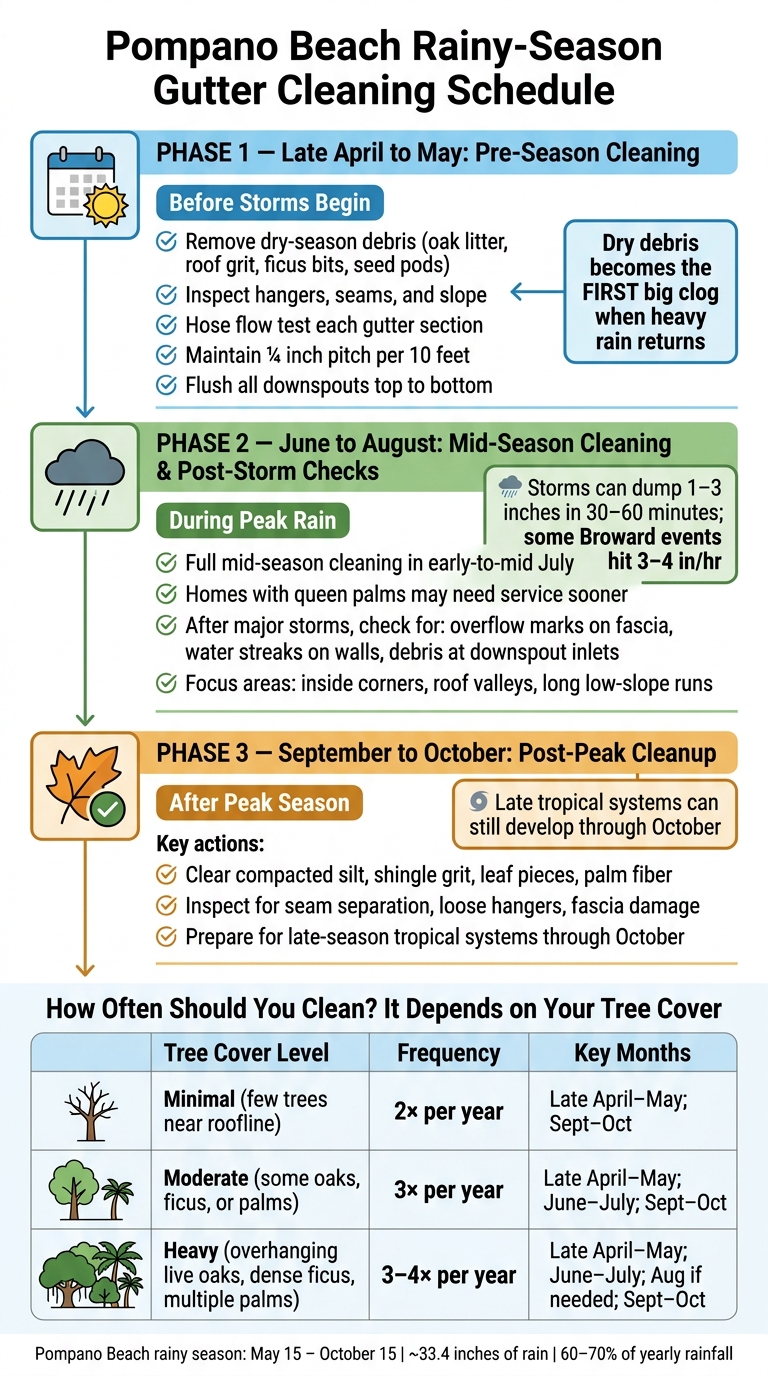
A Rainy-Season Gutter Cleaning Schedule for Pompano Beach Homes
Pompano Beach Gutter Cleaning Schedule by Season & Tree Cover
Pompano Beach gutters need a plan built for repeat storms and thick tree cover, not a basic spring-and-fall routine.
Late April to May: Pre-Season Cleaning and Flow Check
Late April or May is the best time for pre-season cleaning, before Broward’s daily thunderstorms kick in.
Debris from the dry season - packed oak litter, roof grit, dried ficus bits, and seed pods - often becomes the first big clog when heavy rain returns.
A full pre-season visit should include debris removal across the entire gutter run, a close check of hangers, seams, and slope, plus a hose flow test on each section. Keep the pitch at about ¼ inch for every 10 feet so stormwater can move out before outlets start backing up. Each downspout should also be flushed from top to bottom to clear hidden clogs before they turn into a mid-season headache.
Once the system is flowing well, the next step is mid-season checks as storm activity picks up.
June to August: Mid-Season Cleaning and Post-Storm Checks
By early July, several weeks of storms usually bring a fresh layer of pollen tassels, ficus leaves, and palm fibers. If your home sits under live oaks or dense ficus, one full mid-season cleaning in early to mid-July is often the right move. Homes with queen palms may need service a bit sooner, since frond fibers and seed pods can clog outlets fast once steady rain begins.
After major storms, look for a few clear warning signs:
Overflow marks on the fascia
Water streaks running down exterior walls
Debris collecting at downspout inlets
Inside corners, roof valleys, and long low-slope runs are the areas most likely to trap debris between storms, so they need the closest look. If downspout inlets keep clogging, that usually points to the need for a second mid-season cleaning.
By late summer, the problem often shifts. Instead of loose debris, you start seeing packed buildup, which leads into the last cleanup window.
September to October: Post-Peak Cleanup and Canopy-Based Frequency Table
By September, gutters have already handled months of storm runoff. Compacted silt, shingle grit, leaf pieces, and palm fiber can settle into dense plugs at low spots and downspout inlets. Late-season tropical systems can still develop through October, so clearing that buildup before conditions change helps protect the home through the back end of the season. It also makes next year’s pre-season cleaning less of a mess.
This post-peak visit is also a good time to spot seam separation, loose hangers, and fascia damage.
Here’s a simple way to line up cleaning frequency with the amount of tree cover around the home:
Tree Cover Level
Recommended Cleaning Frequency
Key Months
Minimal (few trees near roofline)
2× per year
Late April–May; September–October
Moderate (some oaks, ficus, or palms shading part of the roof)
3× per year
Late April–May; June–July; September–October
Heavy (overhanging live oaks, dense ficus, or multiple palms above roof)
3–4× per year
Late April–May; June–July; August (if needed); September–October
Conclusion: What the Rainy Season Demands From Pompano Beach Gutters
Pompano Beach gutters need attention before rainy season, during the wettest stretch, and again after major storms. Clean before storms roll in, check during peak rain, and clear debris after heavy canopy drop.
Debris from live oak, ficus, and queen palm mats together, forms bridges, and packs down inside gutters. That's why many Broward homes need 3 to 4 cleanings per year rather than the standard twice-yearly schedule. Palm Shine Pros services Pompano Beach on that kind of frequency — the tree cover and storm patterns here make a one-size-fits-all plan fall short.
The most practical timing: a pre-season cleaning in late April or May, a mid-season check from June through August, and a final pass in September or October if tree cover is heavy or storm activity has picked up. For broader exterior prep before the rains arrive, this guide to floodproofing home exteriors covers what to prioritize. This schedule keeps gutters ready for heavy rain — not just looking clean when Pompano Beach gets its heaviest downpours.
How do I know if my gutters need cleaning between scheduled visits?
Inspect your gutters after any major storm. Even between planned cleanings, keep an eye out for signs of a clog.
A few common red flags:
Water spilling over the sides when it rains
Buildup you can see, like palm fronds, pine needles, or other yard debris
Standing water sitting in the gutters
If you spot any of these, clear out the debris and flush the system with a garden hose.
Do gutter guards help with oak, ficus, and palm debris in Pompano Beach?
In Pompano Beach, gutter guards often have a hard time with local debris. They can stop bigger leaves, sure. But palm fronds, heavy pollen, and fine organic sediment can still clog the system or slip right past it.
And when tropical storms dump debris fast, things can go sideways in a hurry. That’s why professional cleaning is still the most reliable way to keep gutters clear and drainage working the way it should.
Should I schedule a gutter check after every major storm?
Yes. Even if you stick to your usual pre-season and mid-season cleaning routine, a major storm can dump heavy debris into your gutters fast. Palm fronds, twigs, and similar mess can lead to clogs almost right away.
If you leave those blockages in place, gutters can overflow. And once that happens, the risk of damage to your home’s foundation and exterior goes up.
.avif)

.avif)