HOA Exterior Cleaning Rules for South Florida Homeowners
Lorem ipsum dolor sit amet, consectetur adipiscing elit. Suspendisse varius enim in eros elementum tristique. Duis cursus, mi quis viverra ornare, eros dolor interdum nulla, ut commodo diam libero vitae erat. Aenean faucibus nibh et justo cursus id rutrum lorem imperdiet. Nunc ut sem vitae risus tristique posuere.
If you live in a South Florida HOA, roof streaks, driveway stains, wall mildew, and dirty gutters can lead to a notice fast - often with about 30 days to fix the issue.
Your HOA will usually check four main areas: roof, driveway, stucco walls, and gutters. In South Florida, about 60 inches of rain a year and humidity often above 70% help algae, mold, and mildew grow fast, which is why these notices show up so often. If you clean the right surface the right way, send dated photos and the paid invoice, and finish the work before the hearing date, you can often avoid a fine.
Here’s the short version:
Roof: Black streaks and algae are a common trigger. Use soft washing.
Driveway: Oil spots, tire marks, and dark buildup get flagged. Use pressure washing with stain treatment.
Stucco walls: Green or gray mildew shows up most on shaded sides. Use low-pressure washing.
Gutters: Debris, overflow marks, and dark streaks can lead to notices. Clean the inside and the outside.
Quick Comparison
Area
What gets flagged
Best cleaning method
Common timing
Roof
Black streaks, algae, moss
Soft wash
Every 2–3 years
Driveway
Oil stains, tire marks, mildew
Pressure wash + pre-treatment
Yearly
Stucco walls
Green or gray growth
Low-pressure wash
Every 1–2 years
Gutters
Debris, overflow stains, dark streaks
Clean-out + brightening
Twice a year
You’ll find the main triggers, cure periods, fine rules, cleaning methods, and proof your HOA may ask for below.
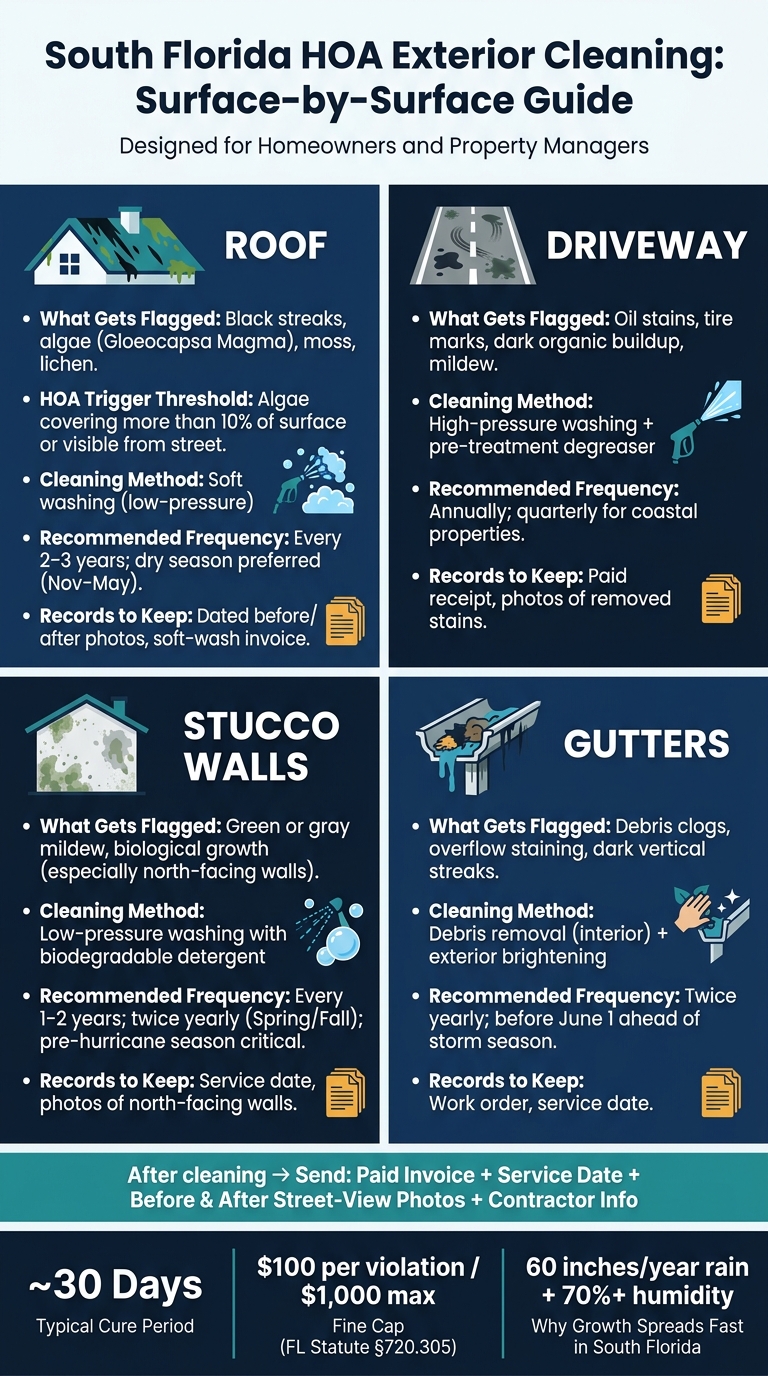
South Florida HOA Exterior Cleaning: Surface-by-Surface Guide
Common HOA Exterior Cleaning Violations and What Triggers Them
In South Florida, HOA notices usually focus on four parts of the home: roofs, driveways, stucco walls, and gutters. If you know what inspectors look for, you have a much better shot at fixing issues before they turn into repeat violations. Most notices start when stains or buildup become easy to spot from the street or through aerial review.
Roof and Driveway Violations Homeowners See Most
The roof issue homeowners see most often is black streaking caused by algae, often called Gloeocapsa Magma. Violation letters usually label it as "visible algae", "black streaking", or "roof discoloration." In many cases, property managers flag a roof when algae covers more than 10% of the surface or when the streaks are plainly visible from the street.
Driveways get cited for different reasons, but the usual ones are oil stains, tire marks, and dark organic buildup. Inspectors may spot these during a walk-through, an aerial review, or after someone files a complaint.
Stucco and Gutter Problems That Draw HOA Attention
Stucco notices often involve green or gray mildew on shaded, north-facing walls. That makes sense in South Florida, where humidity keeps those surfaces damp for longer stretches. Gutters, on the other hand, are often flagged for debris clogs, overflow staining, or dark vertical streaks on the outside.
The chart below shows the usual trigger, likely cause, and the right cleaning method for each surface.
Surface
Common Violation Wording
Likely Cause
Appropriate Cleaning Method
Roof
"Black streaks", "Visible algae", "Staining"
Algae (Gloeocapsa Magma)
Soft wash
Driveway
"Heavy mildew", "Discoloration", "Oil marks"
Humidity, tire tracking, fluid leaks
Pressure wash with degreaser
Stucco/Walls
"Green/gray growth", "Mildew on siding"
Shade and high humidity (especially north side)
Soft wash
Gutters
"Overflow marks", "Dark streaks", "Debris"
Organic buildup and rainwater runoff
Gutter cleaning and brightening
Cleaning Mistakes That Make Violations More Likely
One mistake shows up all the time: cleaning only the spot named in the notice. Growth like algae and mildew usually spreads beyond the one area that got flagged, so a partial cleanup can still lead to another citation.
Another problem is waiting too long. Once staining is obvious, a notice is much more likely. And if you use too much pressure on painted stucco, you can strip paint or scar the surface. At that point, you've swapped one problem for another.
How HOA Enforcement Works After an Exterior Cleaning Violation
A violation notice usually starts the cure process. It does not mean an instant fine. Once your HOA cites an exterior cleaning issue, the main thing to pin down is simple: how much time do you have to fix it?
What a Violation Notice Typically Includes
Under Florida Statute 720.305, the notice should spell out the basics: the inspection date, the property address, the covenant section cited, the visible issue, the cure deadline, and the next enforcement step, which is often a hearing and possible fine.
That visible issue may be something like:
roof staining
driveway buildup
stucco discoloration
gutter overflow marks
If any of that is missing, the notice can feel vague fast. And that matters, because you need to know exactly what the HOA says is wrong before you can fix it.
Cure Periods, Hearings, and Fine Steps Explained
Most communities give homeowners about 30 days to cure exterior cleaning issues. If the problem is still there after that, the HOA can move the matter to a separate fining committee, but only after giving at least 14 days' written notice.
Under HB 1203, effective July 1, 2024, finishing the cleaning before the scheduled hearing date will usually stop a fine for that violation. That's a big deal. In plain English: if you cure the issue before the hearing, you can often avoid the fine altogether.
Fine amounts are usually capped at $100 per violation and $1,000 total.
If you need more time, ask for an extension in writing. It also helps to attach a quote or a signed service agreement. That shows you're not ignoring the notice - you've already started dealing with it.
Once the deadline is clear, the next move is straightforward: clean the cited surface and send proof that the work is done.
How to Fix Roof, Driveway, Stucco, and Gutter Violations
Once you know what the HOA cited, the next step is simple: match the fix to the surface. Use the wrong method, and you can damage the material or end up with another notice right after the first one.
For roof, driveway, stucco, and gutter violations, the right service depends on two things: what the notice says and what the surface can safely handle.
Matching Roof and Driveway Violations to the Right Cleaning Method
Roofs should be cleaned with low-pressure soft washing. High pressure can strip granules and cut down the life of shingles. If you're trying to clear an HOA violation, that's the last thing you want. The goal is to fix the issue before the cure deadline, not trade one problem for another.
Driveways are different. They usually need high-pressure washing plus a pre-treatment for oil, tire marks, and mildew. And here's where people get tripped up: spot-cleaning often looks uneven. If one section is bright and the rest still looks dirty, that patchy finish can lead to a follow-up notice. Treating the full driveway gives it a uniform look.
Stucco and gutters need a lighter touch, but for different reasons.
How to Clean Stucco and Gutters Without Causing Damage
Stucco should be cleaned with low-pressure washing and a biodegradable detergent. Too much pressure can push water behind the surface. That can create a much bigger mess than the one you started with.
Gutter violations often involve more than leaves and buildup. If the notice mentions visible streaking, the fix usually means both debris removal and exterior brightening. Clearing out the inside helps water flow, but it won't remove the stains the inspector saw from the ground.
When Community-Wide Service Planning Makes Sense
If an HOA manager is dealing with multiple notices at once, coordinated service can make life a lot easier. It also helps the whole community look consistent instead of having a few clean homes mixed in with several still under notice.
Bundled community-wide cleanings usually cost 30–40% less per unit than separate residential quotes. They also make it easier to bring every property up to the association's uniform appearance standard on the same schedule. For managers planning ahead, the commercial property maintenance checklist by season is a useful reference. And commercial services can be scoped for multiple buildings, common areas, and entry features under one schedule.
There’s also a legal point worth checking. For communities with 100 or more parcels, Florida Statute 720.3055 requires competitive bids if a contract goes over 10% of the association's total annual budget, including reserves. It’s smart to confirm that before signing anything.
The table below matches each citation to the right service and timing:
Cited Surface
Condition
Recommended Service
South Florida Scheduling
Roof
Black streaks, moss, lichen
Soft washing
Every 2–3 years; dry season preferred (Nov–May)
Driveway
Oil stains, tire marks, algae
High-pressure washing + pre-treatment
Annual; quarterly for coastal properties
Stucco/Walls
Green or gray biological growth
Low-pressure house wash
Twice yearly (Spring/Fall); pre-hurricane season critical
Gutters
Debris clogs, for visible streaking
Debris removal + brightening
Before June 1 to ensure drainage before storm season
After cleaning, send dated photos and the invoice before the cure deadline.
How to Stay Ahead of Future Notices With Scheduling and Documentation
Once the surface is clean, the next move is simple: prove the work was done and make sure it stays that way. A second notice can often be avoided if you keep records and stick to a cleaning schedule. Clean on time, document the job, and send proof right away.
What Documentation to Send After Service Is Completed
Send one email that includes the paid invoice, service date, property address, contractor name and contact info, and before-and-after street-view photos. Use before-and-after photos taken from the same street-facing angle. Some HOAs also ask for a COI or local business tax receipt.
Send that package to the property manager or board, then keep the timestamped email for your records. That timestamp gives you a clear paper trail. After you submit it, ask for written confirmation that the violation is closed.
Once the file is closed, move into a routine that helps keep that same surface from being cited again.
How to Build a Preventive Cleaning Schedule for South Florida
South Florida’s humidity rarely drops below 50–60%, and biological growth speeds up at temperatures above 60°F. In plain English, algae, mold, and mildew don’t take much time off, so your cleaning schedule shouldn’t either.
Plan major cleanings for April or May. That puts you ahead of peak summer growth and storm-season debris. If you wait until the buildup is easy to spot from the street, you may already be on track for a notice.
Here’s a practical schedule:
Surface
Cleaning Interval
Records to Keep
Roof
Every 2–3 years
Dated before/after photos, soft-wash invoice
Driveway
Annually
Paid receipt, photos of removed stains
Stucco/Walls
Every 1–2 years
Service date, photos of north-facing walls
Gutters
Twice yearly
Work order, service date
North-facing walls need extra attention because they stay damp longer.
Key Takeaways for Homeowners and Property Managers
For homeowners and property managers, this comes down to four habits:
Know which surfaces HOAs inspect. Roofs, driveways, stucco, and gutters are the most common targets in South Florida communities.
Act on notices right away. Most come with a 30-day cure period, but repeat offenders may get only 14 days. Fines can reach $100 per violation and up to $1,000 total under Florida Statute §720.305.
Match the cleaning method to the surface. The wrong pressure or chemistry on stucco or tile leads to repeat notices and surface damage — Palm Shine Pros covers exterior washing across material types for exactly that reason.
Keep records. A paid invoice, service date, before-and-after photos, and contractor details in one place can resolve a dispute quickly.
You can handle some outdoor cleaning on your own, especially on tough surfaces like concrete driveways. But there’s a catch: it can get risky fast.
More delicate areas, like roofs, stucco, and siding, are much easier to damage if you use the wrong pressure or technique. That can lead to stripped paint, cracked stucco, or even a voided roofing warranty. In many cases, it makes more sense to hire a pro.
If you decide to do it yourself, make sure you use the right method for the surface. For example, roofs should usually be cleaned with soft washing, not standard high-pressure washing.
What if I need more time?
Don’t ignore the violation notice. Most South Florida HOAs give owners 14 to 30 days to fix the issue. If you can’t get it done in that window, contact your property manager or board in writing right away and ask for more time.
Show good faith. Explain what’s going on, share a professional cleaning quote, and give them a firm date for when the work will be done. That kind of clear communication can often help delay daily fines.
If sidewalks are part of the notice, follow your HOA’s sidewalk rules too.
How do I prove the violation was fixed?
Submit clear proof that the work was done by a professional. In most South Florida HOAs, simple documentation is enough. You usually don't need a huge stack of paperwork.
Include:
Dated before-and-after photos
The property address
The service date
A short description of the work
An itemized invoice from your licensed and insured contractor
If your HOA uses a required format, check with the association or property management team first.
.avif)

.avif)