How Often South Florida Gutters Actually Need Cleaning
Lorem ipsum dolor sit amet, consectetur adipiscing elit. Suspendisse varius enim in eros elementum tristique. Duis cursus, mi quis viverra ornare, eros dolor interdum nulla, ut commodo diam libero vitae erat. Aenean faucibus nibh et justo cursus id rutrum lorem imperdiet. Nunc ut sem vitae risus tristique posuere.
InSouth Florida, manygutters need cleaningmore often than the usual twice-a-year rule. If your property has heavy tree cover, palm debris, storm exposure, or a waterfront location, cleaning may need to happen every 2 to 3 months instead.
You can use this simple rule:
Light tree cover: clean gutters 2 times per year
Heavy tree cover or palms: clean gutters every 3 months
Dense debris during rainy season: clean gutters every 2 months
Waterfront homes: inspect or clean every 2 to 3 months
Commercial and multiunit buildings: clean at least quarterly
After a tropical storm or hurricane: do a spot check right away
That shorter schedule makes sense in a place that gets about 61 to 67 inches of rain per year. South Florida also gets hard summer downpours, hurricane bands, palm litter, pine needles, and roof grit that can clog downspouts fast.
Here’s what matters most:
More trees = more cleanings
More storms = more checks
Guards help, but they do not stop all buildup
Overflow, standing water, sagging, stains, weeds, and mosquitoes mean your gutters are already overdue
Waiting too long can lead to fascia damage, drainage trouble, and repair bills from hundreds to thousands of dollars
South Florida Gutter Cleaning Schedule by Property Type
Quick Comparison
Property type
Usual schedule
Extra note
Light tree cover
Twice a year
Add a storm-season inspection
Heavy tree cover
Every 3 months
Shorten to every 2 months in rainy season if debris is dense
Waterfront home
Every 2 to 3 months
Check windward downspouts after storms
Commercial or multiunit
Quarterly at minimum
Add pre-hurricane-season drain and roof checks
Your best schedule depends on debris load and storm exposure, not just the calendar. The article below breaks down which interval fits your property, what warning signs to watch for, and what can happen when cleanings are spaced too far apart.
sbb-itb-20350f7
How Often Gutters Actually Need Cleaning in South Florida
How often you clean gutters in South Florida comes down to a few simple things: how much debris hits the roof, how exposed the home is, and what kind of building you’re dealing with. In practice, most properties fall into a few clear patterns.
Homes with Heavy Tree Cover, Palms, or Frequent Roof Debris
If your roof sits under live oaks, slash pines, or mature palms, clean the gutters at least every 3 months. Live oak leaves tend to mat together fast at downspout inlets, and a dense plug can form after just one stormy month. Palm pods and fibers also clog screens fast, especially during heavy rain.
For yards with very heavy debris, especially where multiple mature oaks or Australian pines hang directly over the roofline, some South Florida contractors suggest cleaning every 2 months during the rainy season, roughly May through October. A practical schedule looks like this:
One full cleaning in late spring
Another in mid-summer
A post-hurricane-season cleaning in October or November
After any named tropical storm or hurricane, do a spot check at inside corners and above downspouts. That’s where debris usually packs in the tightest.
Less exposed homes can usually wait longer between cleanings.
Homes with Light Tree Cover, Newer Roofs, or Gutter Screens
If your home has light tree cover, a newer roof, and gutter guards that are still doing their job, twice a year is often enough. Late spring and early fall are the usual cleaning windows. It also helps to add one inspection before peak storm season.
Gutter screens help, but they don’t make the system hands-off. Debris still builds up on top of guards, especially at roof valleys and edges. It’s also smart to check seams and end caps for leaks and make sure downspouts are draining freely at ground level. If a severe wind event rolls through, add a spot check even if it lands between scheduled visits.
Waterfront, Commercial, and Multiunit Properties
Waterfront homes usually need more attention than inland homes. They deal with stronger steady winds, airborne salt, and more direct storm exposure. For coastal and Intracoastal properties, inspections every 2 to 3 months are common. After major storms, pay close attention to downspouts on the windward side.
Commercial buildings and multiunit properties have a different risk profile. They often have long gutter runs, fewer downspouts, and drainage systems that connect to underground leaders. One clog can push water back across several units. For these buildings, quarterly cleaning is the minimum, and a pre-hurricane-season check matters even more on flat or low-slope roofs.
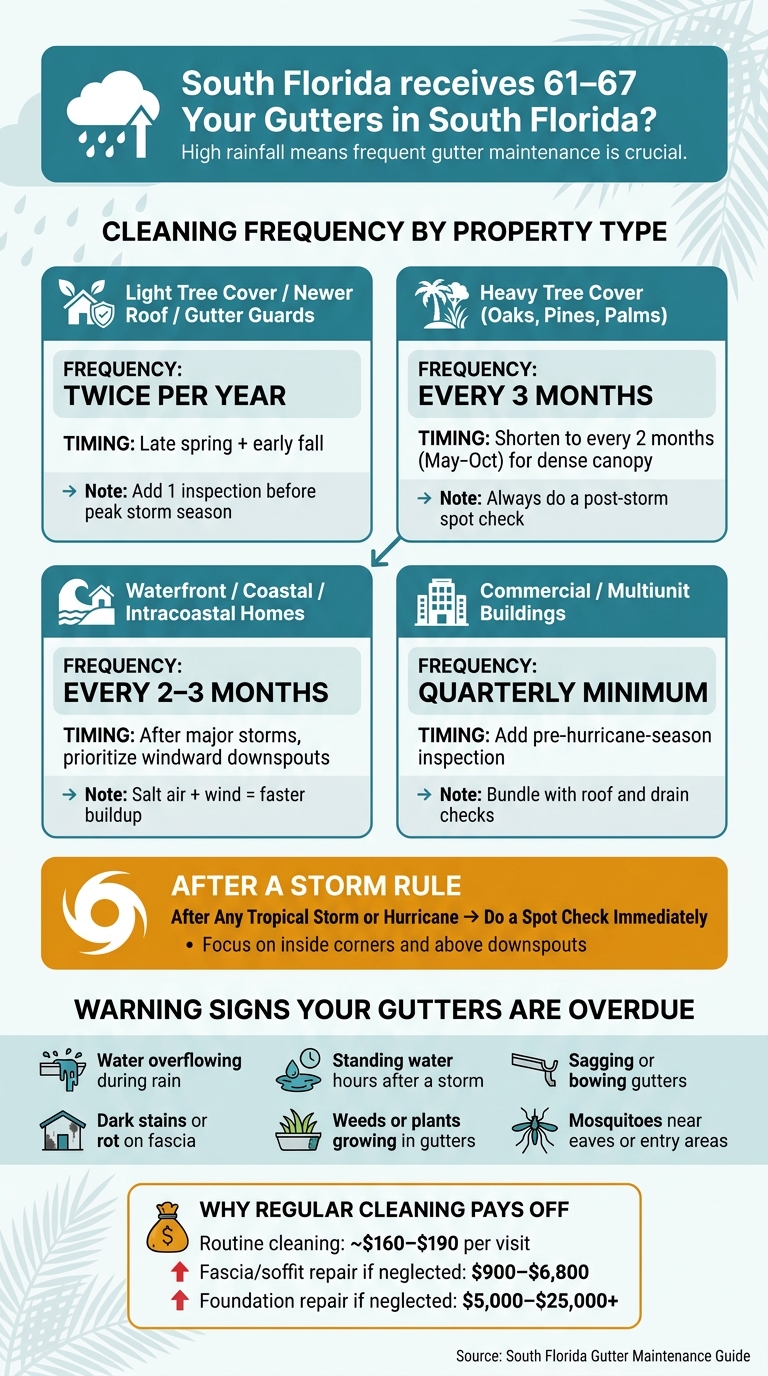
Property Type
Recommended Interval
Key Timing Notes
Heavy tree cover (oaks, pines, palms)
Every 3 months
Add post-storm checks; every 2 months during rainy season for dense canopy
Light tree cover, newer roof, gutter guards
Twice per year
Late spring + early fall; add an extra inspection before peak storm season
Waterfront (coastal/Intracoastal)
Every 2–3 months
Priority: windward downspouts after storms
Commercial or multiunit buildings
Quarterly minimum
Add pre-hurricane-season inspection; bundle with roof and drain checks
Signs Your Gutters Are Overdue for Cleaning
Use the cleaning intervals above as a starting point. But after heavy rain or storms, don’t wait for the calendar if your gutters start showing trouble.
These warning signs mean the system needs attention sooner than planned. At that point, routine upkeep has already slipped into overdue territory.
Overflow, Standing Water, and Clogged Downspouts
The most obvious sign is water spilling over the gutter edge during rain, especially at corners or above entryways. In most cases, debris is blocking the gutter channel or the downspout inlet.
Keep an eye on the downspouts too. If water is pouring over the top but little or nothing is coming out at the bottom, the inlet is clogged. That’s a maintenance problem, not just the result of a hard downpour.
Once the storm passes, walk around the house and check the perimeter. In South Florida’s heat, a gutter with the right pitch should drain within minutes to about an hour. If water is still sitting there hours later, the gutter is either clogged or sloped the wrong way. Either way, it needs service before the next storm moves in.
Sagging Gutters, Fascia Staining, and Landscape Washout
Wet debris gets heavy fast. Over time, gutters filled with standing water and packed leaves can sag, bow, or pull away from the fascia. Step back and look at the roofline. Dips, warped sections, or brackets pulling out of the wood usually mean the system has been overloaded more than once.
The fascia can tell the same story. Look for dark vertical streaks, peeling paint, or soft wood below the gutter line or behind downspouts. Those marks often mean water has been running over the edge and down the fascia instead of flowing through the downspout. In South Florida’s humid climate, repeated soaking can speed up rot much faster than in drier areas.
Now check the ground below the eaves after rain. Soil channels, mulch pushed out of place, or sand missing between paver joints are all signs that water is falling straight off the roof edge instead of being carried away. If the same areas get disturbed after every storm, the gutter above them is probably blocked.
Mosquitoes, Weeds, and Nesting Debris
If you can see weeds or small plants growing in the gutter, debris has built up long enough to form a soil-like layer. In South Florida’s warm, wet weather, that can happen in a single rainy season under heavy tree cover, especially beneath live oaks or royal palms where seeds and organic matter pile up fast. Visible plant growth is a clear signal to book cleaning now, not at the next scheduled visit.
Standing water in clogged gutters is also a prime breeding spot for mosquitoes. In warm weather, they can hatch and multiply within days. So if mosquito activity around your eaves, patio, or front entry feels high even after you’ve dealt with puddles on the ground, check the gutters. They may be the source.
Other pest clues matter too:
Mud nests on the fascia
Wasp structures near downspout inlets
Nesting material around gutter openings
These signs often mean the gutter is staying wet and giving pests a place to settle in.
Public health and vector-control guidance also names rain gutters, along with tires and buckets, as common sources of standing water that should be emptied or cleaned to help control mosquitoes.
Treat any gutter that stays wet for more than a day or two as a priority.
What Happens When Gutters Go Too Long Without Cleaning
Once gutter cleaning falls behind, the issue stops being simple upkeep and starts turning into repair work. When gutters stay clogged, water backs up and damage can spread in a hurry. Most of the time, the first signs show up at the roof edge. After that, the trouble often moves down to the foundation and the ground around the house.
Roof-Edge, Fascia, and Exterior Water Damage
When gutters clog, water has nowhere to go except over the side or back toward the roofline. That kind of overflow, again and again, can soak fascia boards and soffits, stain trim, and leak into the eaves or wall edges. In South Florida’s humid climate, that trapped moisture tends to stick around longer, which speeds up rot and mold growth.
The repair bills aren’t small. Replacing damaged fascia in South Florida usually costs $15 to $25 per linear foot, and a full replacement on a single-story home with 150 to 200 linear feet of fascia can run $2,500 to $5,000. Soffit and fascia repair more broadly falls between $9 and $34 per linear foot, depending on the material and how bad the damage is. That’s a big bill for a problem that routine cleaning may have helped avoid.
Foundation, Pavers, and Entry-Area Drainage Problems
A clogged gutter dumps runoff into one spot instead of letting water spread out the way it should. On flat lots, that gets worse fast because the water has fewer places to drain. It can pool near the slab or soak into the ground right against the foundation, building pressure against foundation walls that may lead to cracks, settling, and leaks.
Foundation repair tied to long-term drainage failure can cost $5,000 to $25,000 or more. And here’s the part that stings: insurance often denies claims when the damage traces back to gutter neglect.
Routine Cleaning vs. Neglected Gutters: Side-by-Side Comparison
The difference in cost is easiest to see when you put the numbers next to each other.
Factor
Routine Cleaning
Neglected Gutters
Risk level
Low
High
Typical cleaning cost
~$160–$190 per visit
Higher overall cost if repairs are needed alongside cleaning
Potential repair costs
Minimal
Fascia/soffit: $900–$6,800; foundation: $5,000–$25,000+; water damage: $10,000–$35,000+
The math is pretty simple. Routine cleaning is a steady, predictable cost. Neglected gutters can set off a string of repair issues - wood repair, drainage fixes, pest control, and, in bad cases, water remediation - and those costs can pile up fast, often with the homeowner paying out of pocket.
Conclusion: A Practical Gutter Maintenance Benchmark for South Florida
Overflowing gutters, standing water, or debris packing up before the next scheduled cleaning are all signs the gap between services is too long. In South Florida, the right schedule comes down to two things: how much debris the property collects and how much storm exposure it gets. Palm Shine Pros structures gutter cleaning around both — not a fixed interval applied the same way across every property.
Use These Benchmarks to Plan Service Before the Next Storm
Use these cleaning intervals as the benchmark:
Homes with light tree cover usually need two cleanings a year - one before the summer wet season and one after hurricane season.
Tree-heavy properties with overhanging palms, live oaks, or dense landscaping need cleaning every 2 to 3 months.
Waterfront, commercial, and multiunit properties should default to quarterly maintenance with added storm-season checks.
If your property falls into a higher-risk group, shift to the shorter interval now. Set the next cleaning before the next storm cycle, not after damage begins.
FAQs
How do I know if my gutters need monthly checks?
In South Florida, it often makes sense to check your gutters every month if your property has dense vegetation or overhanging trees. Those conditions can fill gutters with leaves and debris fast.
You should also inspect your gutters right after any major storm or hurricane. In this part of the country, heavy rain and high winds can clog drainage in no time.
For most homes, gutter maintenance is usually suggested twice a year. But if debris builds up fast, you’ll want to check them more often to help prevent:
Overflow
Foundation damage
Fascia rot
If your drainage is blocked or water starts pooling near your foundation during rain, service is overdue.
Do gutter guards reduce how often cleaning is needed?
The available information does not say whether gutter guards cut down how often gutters need cleaning.
What it does say is this:
South Florida properties usually need gutter cleaning twice a year
Homes with dense vegetation may need cleaning 3 to 4 times a year
That’s the full scope of the source. It does not explain how gutter guards affect that schedule or what kind of upkeep they change.
What should I inspect after a tropical storm?
After a tropical storm, put safety first. Treat any downed power line as live, and stay well back.
Once it’s safe, check your roof, siding, trees, and gutters for damage. Look for loose or unstable areas, storm debris, and any clogs that could stop water from draining.
Clear out fallen palm fronds, leaves, branches, silt, twigs, and seed pods as soon as you can. Then make sure your downspouts are open and sending water at least 3 feet away from your home. That small check can help prevent stains, standing water, rot, and foundation problems.
Lorem ipsum dolor sit amet, consectetur adipiscing elit, sed do eiusmod tempor incididunt ut labore et dolore magna aliqua. Ut enim ad minim veniam, quis nostrud exercitation ullamco laboris nisi ut aliquip ex ea commodo consequat. Duis aute irure dolor in reprehenderit in voluptate velit esse cillum dolore eu fugiat nulla pariatur.
.avif)

.avif)