Lorem ipsum dolor sit amet, consectetur adipiscing elit. Suspendisse varius enim in eros elementum tristique. Duis cursus, mi quis viverra ornare, eros dolor interdum nulla, ut commodo diam libero vitae erat. Aenean faucibus nibh et justo cursus id rutrum lorem imperdiet. Nunc ut sem vitae risus tristique posuere.
Pool cages in South Florida get dirty fast because salt air, humidity, rain, and pool splash leave behind oxidation, algae, mold, and mineral spots.
If you want the short answer, here it is: safe pool cage cleaning meanslow-pressure soft washing, spot treatment for mineral buildup, and careful rinsing that does not stretch screens or knock out spline. In many South Florida homes, exterior surfaces can show algae growth in as little as a few months, and salt exposure can make aluminum frames look chalky or faded long before the cage is old.
Here’s what matters most to you:
Three main problems show up: oxidation on aluminum, algae or mold on mesh, and calcium buildup on lower rails
High pressure is the wrong tool: it can leave tiger striping, tear mesh, or loosen spline
Soft washing does most of the work: cleaning solutions loosen buildup, then low pressure rinses it away
Some wear will stay: cleaning can remove chalky residue, but it cannot fix faded paint or brittle screens
Most cages need service every 8 to 16 months, depending on salt exposure, shade, trees, and irrigation spray
A fast side-by-side view:
Buildup
Where it shows up
What it looks like
Best cleaning approach
Oxidation
Aluminum frame
White chalk, dull finish
Soft wash and gentle chemical treatment
Algae and mold
Screen mesh, corners, frame edges
Green film, dark streaks
Low-pressure soft wash and light brushing
Calcium deposits
Lower rails, splash zones
White spots or crust
Acid-based cleaner, then neutralizing rinse
This gives you the full picture before the step-by-step process starts.
This Painted Pool Deck Was FILTHY 😳 | Soft Wash Pool Cage Cleaning – Bradenton FL
sbb-itb-20350f7
What Builds Up on Pool Cage Frames and Screens
In South Florida, pool cages usually pick up three main types of buildup: aluminum oxidation on the frame, algae and mold on the mesh and along frame edges, and calcium or mineral deposits on the lower rails. They don’t all look the same, and they shouldn’t be cleaned the same way either.
Aluminum Oxidation From Salt Air and Humidity
South Florida’s salt air, high humidity, and UV exposure slowly wear down painted aluminum frames. As that happens, a white, chalky residue forms on the surface. It almost feels like talc if you run your finger across it. On darker frames, it often shows up as a light haze that makes the whole cage look faded.
This kind of oxidation affects the finish itself, not just the top layer. Cleaning can take off the chalky residue, but if the paint underneath has already broken down, the original shine may not come back all the way.
Algae and Mold on Screen Mesh and Frame Edges
Moisture is the main cause here. Shaded corners, lower screen panels, and frame joints where water sits after rain are usually the first spots where algae and mold start to grow. You’ll often see a green film across the mesh or dark streaks along the frame edges.
A dry cloth won’t take that off. It needs the right cleaner and the right amount of pressure.
Calcium and Hard Water Deposits on Lower Rails
The lower rails of a pool cage deal with the most water exposure. Pool splashback leaves dissolved minerals behind, and once that water dries in the sun, it can leave white spots or even a hard crust on the frame. Irrigation overspray can do the same thing over time.
Calcium deposits need an acid-based cleaner before rinsing.
Once you know what’s on the cage, you can choose a cleaning method that fits the surface and helps avoid damage.
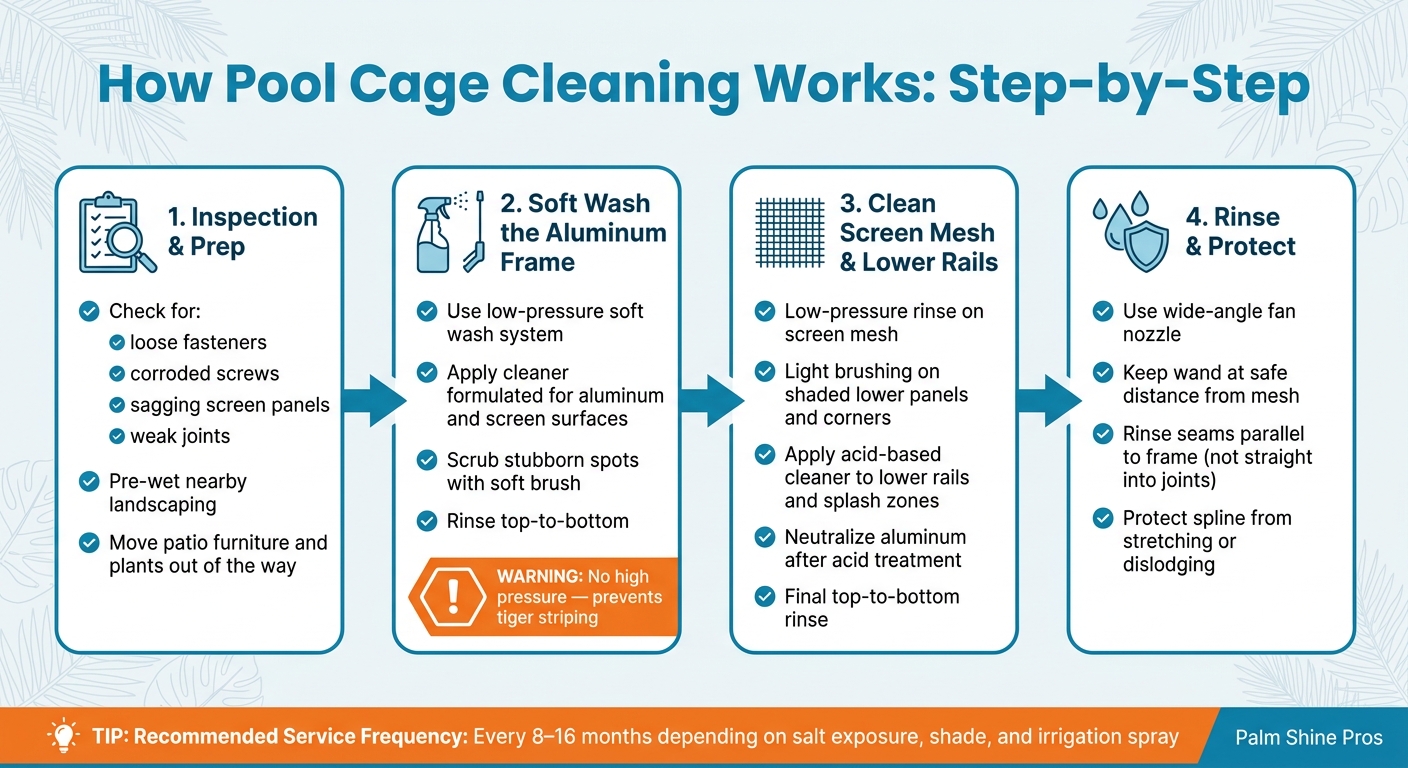
How Pool Cage Cleaning Works Step by Step
Pool Cage Cleaning Process: Step-by-Step Guide for South Florida Homes
Once the buildup has been spotted, the work moves into four main parts: inspection, protection, washing, and rinse-off.
Inspection, Prep, and Protection Before Washing
Start by checking the cage for loose fasteners, corroded screws, sagging screen panels, and weak joints. In coastal areas, salt air can wear down hardware fast, so any worn or damaged parts should be flagged before washing starts.
After that, prep the area around the cage. Move patio furniture, potted plants, and decorative items out of the way so they don't get hit by overspray. Any fixed landscaping should be pre-wetted before the cleaning solution goes on, then rinsed again during and after the job. That helps dilute runoff caused by salt air, humidity, and pool water contact.
With the cage and nearby areas protected, the washing can start.
Soft Washing the Aluminum Frame Without Damaging the Finish
The aluminum frame is washed with a low-pressure soft wash system and a cleaner made for aluminum and screen surfaces. That solution helps break down algae and mold. If a few spots hang on, a soft brush takes care of them, and then a top-to-bottom rinse washes everything away.
This part matters because high pressure on painted aluminum can scratch the finish. On frames that already show oxidation, it can also make fading worse.
After the frame is cleaned, the mesh and lower rails are handled on their own.
Cleaning Screen Mesh and Lower Frame Sections
The screen mesh is rinsed with low pressure, and any stubborn growth on shaded lower panels and corners is brushed lightly. Lower rails and splash zones are then treated on their own with an acid cleaner. After that, the aluminum is neutralized to stop the reaction.
A final top-to-bottom rinse flushes loosened debris off the cage.
Why Pressure Limits and Screen Tension Matter
After the cleaner loosens buildup, pressure control is what keeps the cage from getting damaged during the rinse.
Pool cage cleaning isn't the same as washing a driveway or patio. You're dealing with painted aluminum and stretched screen mesh, and both have hard limits. Push past those limits, and the damage can be permanent.
How Too Much Pressure Damages Aluminum and Screens
High pressure can remove buildup unevenly and leave marks on both the aluminum and the screen mesh.
On aluminum frames, the main problem is uneven oxidation removal. If oxidation gets blasted off with pressure instead of being loosened with the right cleaning solution, it tends to come off in patches. That pattern is called tiger striping. Once it shows up, the finish is permanently scarred.
The frame is at risk, but the mesh and spline are even easier to damage.
With screen mesh, the damage often happens fast. Too much pressure can cut through weak mesh or stretch it out of shape. The spline is the weak point. A tight stream of water can knock it out of its channel, which causes panels to sag.
How Proper Technique Protects Screen Tension and Seams
Once buildup has been loosened, the rinse should stay low enough to protect the mesh and spline. In soft washing, the cleaning solution does the heavy lifting. The water is there to rinse it away.
Technique matters here more than most people think:
A wide-angle fan nozzle spreads water across a broader area instead of hitting one small spot.
Keeping the wand at a safe distance from the mesh helps stop the force of the water from stretching or tearing it.
Seams and joints should be rinsed parallel to the frame, not sprayed straight into them.
Soft washing helps protect mesh tension and seams. High pressure can lead to tears, loose spline, and damage to the finish.
In South Florida, heat cycles make aluminum frames expand and contract. Over time, that movement can loosen the spline's grip. That's why a low-impact method matters even more on older cages. It gives the original finish the best chance of staying intact.
Restoring the Original Appearance and Keeping It That Way
A deep clean clears away the grime that makes a pool cage look tired and helps bring it closer to its original finish.
What Cleaning Removes and What Oxidation May Leave Behind
Cleaning can make a big difference in how a pool cage looks. But it can't fix every kind of wear.
Soft washing removes surface buildup like organic growth, salt residue, and mineral spotting without harming the frame or screens.
Oxidation is a different story. On painted aluminum frames, it often shows up as a chalky white residue. Cleaning can remove the loose powder, but if the finish has already worn unevenly, some fading or tiger-striping may still remain. That's where cleaning reaches its limit on an older finish.
Cleaning also won't bring back brittle or sagging mesh. If screen panels are damaged, they need to be replaced.
A Simple Maintenance Schedule for South Florida Pool Cages
In South Florida, salt air, humidity, and irrigation overspray can wear on a pool cage fast. A simple routine helps stop light buildup from turning into a much bigger job.
Task
Area Focus
Typical South Florida Trigger
Visual inspection
Lower rails and shaded corners
Monthly; look for green algae or slimy spots
Oxidation check
Painted aluminum beams
When frames look dull or leave white residue on touch
Hardware check
Doors, hinges, and main beam screws
Annually; check for white powder or rust
Soft wash cleaning
Frame, mesh, and splines
Every 8–16 months depending on salt exposure and nearby foliage
Conclusion: Key Steps in Safe Pool Cage Cleaning
Safe pool cage cleaning comes down to four basics: identify the buildup, use soft washing on aluminum, keep pressure low, and protect screen tension.
Each problem needs its own fix. Organic growth, calcium deposits, and oxidation don't behave the same way. Soft washing helps avoid tiger-striping and damage to the finish. Low pressure helps protect screen tension and spline seams. A steady cleaning schedule also keeps heavy accumulation from piling up in the first place.
Can an old pool cage look new again after cleaning?
Yes. The right cleaning can make an old pool cage look new again. It safely removes chalky oxidation, algae, and mold from the painted aluminum frame.
It also clears buildup from the screen mesh, which helps it dry taut and look clear. Using soft washing instead of high pressure helps protect the enclosure’s finish and structure while bringing back its original look.
How do I know if my pool cage needs cleaning or repair?
Do a careful walk-around at dusk. Look for light leaks at seams, loose spline corners, or wavy screen mesh. Check the aluminum frame for white powder from oxidation, rust stains around screws, and any play in the door hinges.
If more than one-third of the screen panels are worn or sagging, a full rescreen is often a better use of time than fixing panels one by one.
Is pool cage cleaning safe for screens, plants, and painted aluminum?
Yes - when done with soft washing, pool cage cleaning is safe for screens, plants, and painted aluminum.
High pressure can stretch or tear older mesh. It can also strip paint or dull painted aluminum over time. Soft washing takes a gentler approach. It uses biodegradable cleaners to remove organic growth and oxidation without that kind of force.
Plants matter too. That’s why plant-safe steps - like pre-soaking nearby greenery and controlling runoff - help shield the landscaping around your pool cage.
Lorem ipsum dolor sit amet, consectetur adipiscing elit, sed do eiusmod tempor incididunt ut labore et dolore magna aliqua. Ut enim ad minim veniam, quis nostrud exercitation ullamco laboris nisi ut aliquip ex ea commodo consequat. Duis aute irure dolor in reprehenderit in voluptate velit esse cillum dolore eu fugiat nulla pariatur.
.avif)

.avif)