What Roof Algae in South Florida Signals About Your Home
Lorem ipsum dolor sit amet, consectetur adipiscing elit. Suspendisse varius enim in eros elementum tristique. Duis cursus, mi quis viverra ornare, eros dolor interdum nulla, ut commodo diam libero vitae erat. Aenean faucibus nibh et justo cursus id rutrum lorem imperdiet. Nunc ut sem vitae risus tristique posuere.
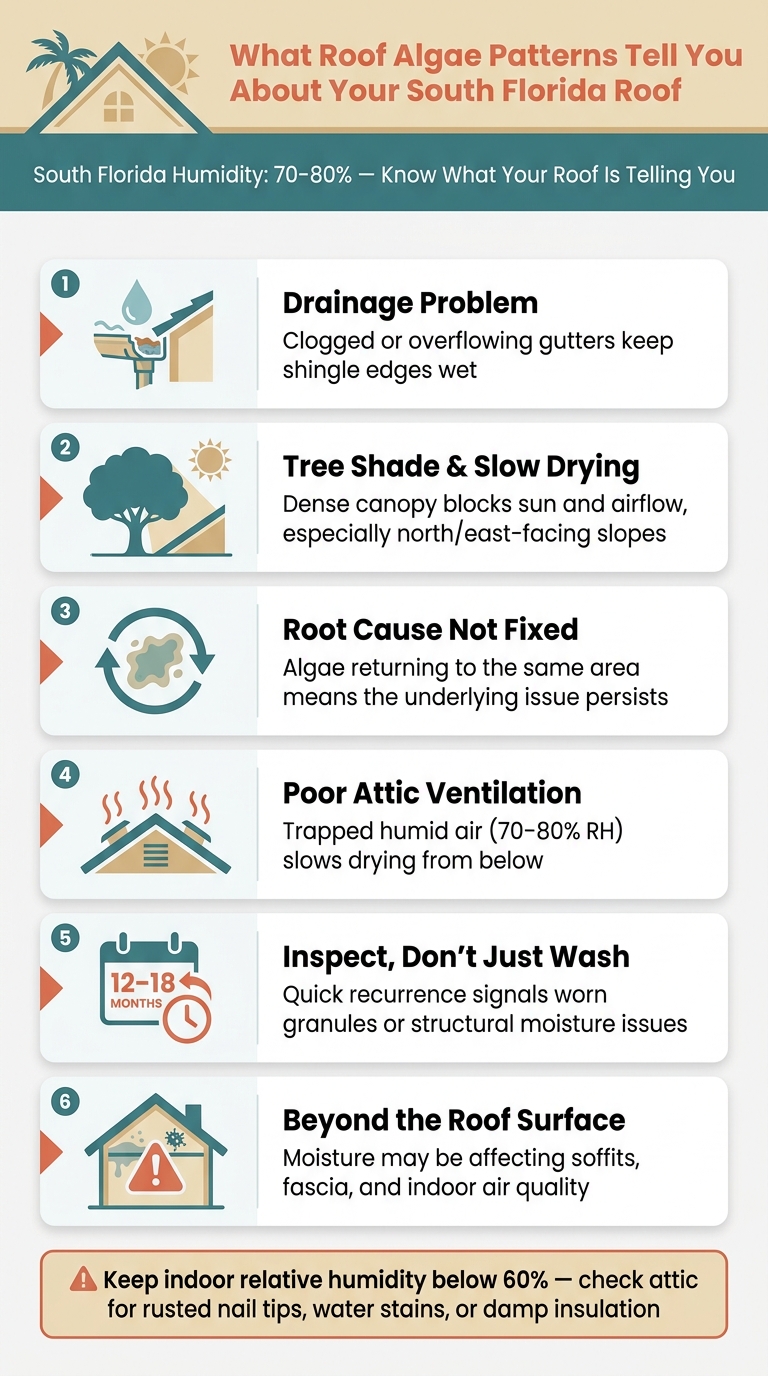
Dark roof streaks in South Florida often mean a moisture problem, not just a dirty roof.
If algae keeps showing up, your roof may be drying too slowly because of shade, clogged gutters, poor drainage, weak attic airflow, storm debris, or aging shingles. In a hot, humid area where outdoor humidity often sits around 70% to 80%, those damp spots can stick around long enough for algae to keep coming back.
Here’s the short answer:
Streaks near edges or above gutters often point to drainage trouble
Growth on one shaded slope often points to tree cover and slow drying
Repeat staining in the same spot often means the root cause was never fixed
Staining near ridges or vents can point to trapped heat and humidity in the roof system
Fast return within 12–18 months after cleaning means it is time to inspect the roof, not just wash it again
Algae plus attic stains, damp insulation, or musty smells can mean the issue goes past the roof surface
A few simple checks can help: look for roof areas that stay dark 2–4 hours after rain, watch for gutter overflow, and check the attic for rusted nail tips, water marks, or damp insulation. If algae appeared after storm season, that can also point to shifted shingles, blocked valleys, or debris holding water in place.
Below, the article breaks down what each algae pattern may say about your roof and when cleaning alone is not enough.
Roof Algae Warning Signs in South Florida: What Each Pattern Means
What roof algae says about moisture and drying conditions
Once you see where algae shows up, the next step is figuring out why those parts of the roof stay damp so long.
Algae tends to build up in the spots that dry last after rain, overnight humidity, or morning dew. In South Florida, frequent storms and thick humidity can keep some roof sections wet much longer than others.
Here’s a simple way to check: look at the roof 2–4 hours after a normal rain on a warm, breezy day. If some areas still look darker or glossier while the rest of the roof has started to lighten, those sections are hanging onto moisture too long. And if the same areas still look wet after storm after storm, you’re likely dealing with a long-term damp zone. That’s almost always where algae begins to show up.
Poor drainage at roof edges can keep sections wet longer
If those damp areas line up with the roof edge, drainage is often the issue.
Clogged or undersized gutters can force water back onto the lower rows of shingles. Debris along the eaves, like palm fronds, seed pods, and leaf litter, can act like a sponge and hold water against the roofing material for hours after the rain ends. A damaged or badly installed drip edge can make things worse by letting water wick back under the shingle edge instead of draining into the gutter.
That creates long-term dampness along the roof perimeter, which gives algae the kind of setup it likes.
During a heavy rain, watch for places where gutters spill over or where water splashes against the fascia. Those trouble spots often match the stained shingle edges above.
Heavy tree shade can slow drying across roof sections
If the pattern follows the tree line instead of the roof edge, shade is usually the main cause.
A dense canopy blocks sunlight, keeps the roof surface cooler, and reduces airflow. In South Florida, that matters a lot. Shaded roof slopes can stay cool enough overnight to hold condensation and morning dew longer than sections that get direct sun.
Trees also add another problem: they drop organic debris right onto the roof. Pollen, leaves, and sap can feed algae and give it a rougher surface to cling to. That’s why heavily shaded areas, especially north- and east-facing slopes near large trees and palms, are often the first places algae appears and the fastest places it spreads.
If one roof slope stays darker than the others, the canopy above it is probably the reason.
sbb-itb-20350f7
What recurring algae can reveal about the roof system itself
If shade and drainage don't explain the pattern, the next place to look is the roof system itself. When algae keeps coming back in the same spots - especially near the ridge, in valleys, or around vents and other penetrations - those areas are often holding moisture or losing their surface defense.
Poor ventilation can trap humidity under ridge caps and in the roof system
When attic ventilation is weak, warm, humid air can get stuck in the attic and roof space. That slows drying from below, even if the roof looks dry from the outside.
Staining that keeps showing up near the upper part of the roof, especially close to the ridge, can point to hot, humid air that isn't escaping well. In South Florida, where outdoor humidity often stays in the 70% to 80% range, a poorly ventilated attic can make that issue worse. If the attic feels hotter than it should, smells musty, or has damp insulation, the roof system is probably holding more moisture than it should.
Worn or missing copper granules can reduce algae resistance on shingles
If the same dark streaks keep returning on older shingles, the surface layer may be wearing down.
Many modern asphalt shingles are made with copper-based granules. When those granules get wet, they slowly release copper ions that make the surface less welcoming for algae. As shingles age and weather, that granule layer starts to wear away, and algae can return faster.
When one older section keeps staining while nearby shingles stay cleaner, that often points to surface wear in that area instead of a drainage or shade issue. Check for shingles that look:
Smooth
Glossy
Faded
Those signs of granule loss often line up with the same places where staining comes back first.
Storm damage can create the conditions algae needs to take hold
A recent storm can leave behind hidden drainage and surface issues, even when the roof still looks fine at a glance.
Wind and heavy rain can slightly lift shingles, weaken flashing, or push organic debris - leaves, twigs, seed pods - into valleys and gutters. Once that debris sits there, it can hold water against the shingle surface for hours or even days.
If algae shows up or gets worse after storm season, that's often a sign that the roof's drainage or surface condition was disturbed. Understanding how South Florida storms affect roofs helps connect the weather event to the growth that shows up later. For example, a tight cluster of staining along one edge or valley after storm season can point to the exact area where the roof took a hit.
That's the kind of lingering moisture algae feeds on. When that pattern shows up, inspection and cleaning are usually the next step.
What roof algae may mean for the rest of the home
Roof algae by itself doesn't automatically mean there's mold in the house. But in South Florida, it does deserve a closer look.
Roof algae can point to wider moisture exposure
When one part of a roof stays wet long enough for algae to grow, the problem may not stop at the shingles or tiles. Soffits, fascia, and the wall below the roofline can take a hit too. Water runoff from algae-heavy areas may keep soaking those surfaces, and over time that can show up as peeling paint, soft or swollen wood, or dark streaks on exterior walls. This tends to happen most where gutters overflow or water keeps landing in the same place.
If the outside below the stain looks fine, the attic is the next place to check. The same damp conditions that help algae grow on the roof can also push attic humidity higher. If you can get into the attic safely, look near the stained roof section for:
Water stains
Damp insulation
Rusted nail tips
A musty smell
Those signs suggest roof moisture may be affecting materials inside the home.
When roof staining lines up with moisture signs in the attic, this is no longer just a surface issue. A good first move is to walk the outside below any algae-stained sections and check the gutters, soffits, and nearby walls for signs of repeat wetting. Inside the home, a basic hygrometer in the main living area and near the attic access can help you see whether humidity is staying in a safe range. Keep indoor relative humidity below 60%.
If you spot those signs, the issue has gone past the roof surface. The mold-free living guide for South Florida explains how outdoor biological growth connects to a broader plan for keeping the home dry from the roof down.
That’s when inspection matters more than appearance.
When algae staining should prompt a professional inspection or cleaning
Some dark streaks are just ugly. Others keep coming back because something on the roof is helping algae grow. That’s the difference that matters.
This section isn’t about spotting every stain. It’s about knowing when the roof needs an inspection instead of yet another rinse.
Signs the issue is no longer just cosmetic
The biggest sign is recurrence. If algae streaks come back within 12–18 months after a prior cleaning, the root cause hasn’t been fixed yet.
A few other patterns should also put roof inspection on your radar:
Staining that spreads fast across multiple roof planes
Dark bands grouped along roof edges, above gutters, or along ridge lines
Once algae shows up alongside curling shingles, granule loss, soft spots, or rusted flashing, you’re likely dealing with roof wear, not surface staining alone. At that point, an inspection makes sense.
If the inspection shows the problem is only on the surface, cleaning is usually the next move. Soft washing is generally the go-to method for South Florida roofs. Pressure washing can strip shingle granules and may void manufacturer warranties. For more detail, the roof cleaning guide comparing soft washing vs. pressure washing breaks it down.
Yes. Roof algae can point to a moisture issue, like poor drainage along the roof edge or humidity trapped beneath the roof covering.
It doesn't automatically mean you have an active leak. But it does point to damp conditions that stick around, and those conditions can line up with leak risk, especially in humid South Florida weather.
If the algae keeps coming back, it's smart to check for drainage or ventilation problems.
Why does algae keep returning to the same spot?
Algae keeps coming back to the same parts of a roof because those areas keep giving it what it needs to grow.
The usual reasons are poor drainage along roof edges, heavy tree shade, trapped humidity under ridge caps, lost copper granules on shingle tiles, or storm damage that leaves behind small crevices where moisture sits.
When should roof algae trigger an inspection?
Schedule a roof inspection as soon as you spot green or black streaks. In South Florida, algae can stain a tile roof in as little as 12 to 18 months, so it pays to act early.
Pay close attention to north-facing sections, overhangs, and spots near irrigation systems. Those damp, shaded areas give algae the kind of conditions it likes. Fast action can slow the spread and help prevent more serious damage to your property.
.avif)

.avif)