What Screen Enclosure Cleaning Removes in South Florida
Lorem ipsum dolor sit amet, consectetur adipiscing elit. Suspendisse varius enim in eros elementum tristique. Duis cursus, mi quis viverra ornare, eros dolor interdum nulla, ut commodo diam libero vitae erat. Aenean faucibus nibh et justo cursus id rutrum lorem imperdiet. Nunc ut sem vitae risus tristique posuere.
In South Florida,screen enclosure cleaningremoves more than dirt: it clears algae, pollen film, bird droppings, white calcium stains, mold in frame channels, and salt residue near the coast.
If your attached lanai or patio screen looks cloudy, green, chalky, or stained, a basic rinse usually won’t fix it. High humidity that often sits near 80%+, yearly rainfall above 60 inches, irrigation overspray, and coastal air all leave buildup on the mesh and aluminum frame.
Here’s the short answer to what gets removed:
Green algae on damp lower panels and shaded sides
Yellow pollen film stuck in the screen mesh
Bird droppings baked onto screens and frames
White calcium and mineral scale on lower aluminum sections
Mold and mildew hiding in roofline channels and joints
Salt residue on coastal homes, often within 5–10 miles of the shore
You should also know what cleaning does not solve the problem well:
A garden hose removes loose dust and light debris
DIY chemicals can harm mesh or aluminum
High pressure can stretch screens, loosen spline, or tear fibers
Soft washing is used to treat stuck organic growth and mineral buildup with low pressure
Quick comparison:
Method
What it removes
Risk to screens/frames
Best use
Garden hose
Loose dust, light surface debris
Low
Short-term rinsing
DIY cleaning
Some surface grime and droppings
Medium
Small spots, with care
Pressure washing
Visible grime
High
Poor fit for screen mesh
Professional soft washing
Algae, mold, pollen film, bird droppings, calcium, salt residue
Low
Full enclosure cleaning
After cleaning, homeowners usually notice clearer screens, cleaner lower frames, and less buildup in hidden channels. The rest of the article explains what collects on attached screen enclosures, why it sticks, and why low-pressure treatment works better than rinsing alone.
This Painted Pool Deck Was FILTHY 😳 | Soft Wash Pool Cage Cleaning – Bradenton FL
What Builds Up on Screen Panels and Aluminum Frames
South Florida screens pick up more than plain dirt. What sticks to them is bonded buildup that settles on the mesh, lower frame sections, and roofline channels. Once it attaches to those surfaces, a basic hose rinse usually leaves most of it behind.
Green Algae, Pollen Film, and Bird Droppings on Screen Surfaces
Green algae often shows up first on the lower panels and shaded sides. Those spots stay damp from lawn overspray and rain splash, so the mesh doesn’t get a chance to dry out. The result is green staining that gets worse the longer it sits.
Pollen season brings a different mess. Many lanai screens end up with a yellow film made from pollen, dust, and moisture stuck together. That film can hold mold spores inside the screen pores, and it tends to stand out most on south-facing panels.
Bird droppings create another problem. They stick to both mesh and frames, and their acidity can wear down screen fibers and the frame coating. Under the Florida sun, they can bake onto the surface and become much tougher to remove.
The same pattern shows up with mineral deposits and hidden mold. Both settle in places where water tends to collect.
White Calcium Deposits on Lower Frames From Irrigation
That chalky white residue on lower frames usually comes from irrigation overspray and mineral scaling. When sprinkler heads hit the frame over and over, the water evaporates and leaves mineral residue behind. As that keeps happening, the residue turns into a visible crust that dulls the finish.
This type of buildup is usually limited to the lower sections of the frame, closest to ground-level irrigation heads.
Mold in Roofline Frame Channels and Coastal Residue in Hidden Areas
Roofline channels and frame joints are the spots many homeowners overlook. These recessed areas can trap standing water, dead bugs, and decaying organic debris. That gives mold and mildew a shaded, damp place to grow.
For homes near the coast, salt residue settles into those same tight joints and hardware areas. Over time, it forms a corrosive crust that speeds up oxidation and can weaken the frame itself. For more on how coastal conditions affect these surfaces, see this guide to exterior cleaning on coastal homes. To learn more about the health effects of mold growth in these channels, see this mold-free living guide for South Florida.
These are the main deposits a professional cleaning needs to break down, not just wash over. Since each one bonds in its own way, a simple hose rinse usually misses most of the problem.
Why a Garden Hose and Common DIY Methods Do Not Solve the Problem
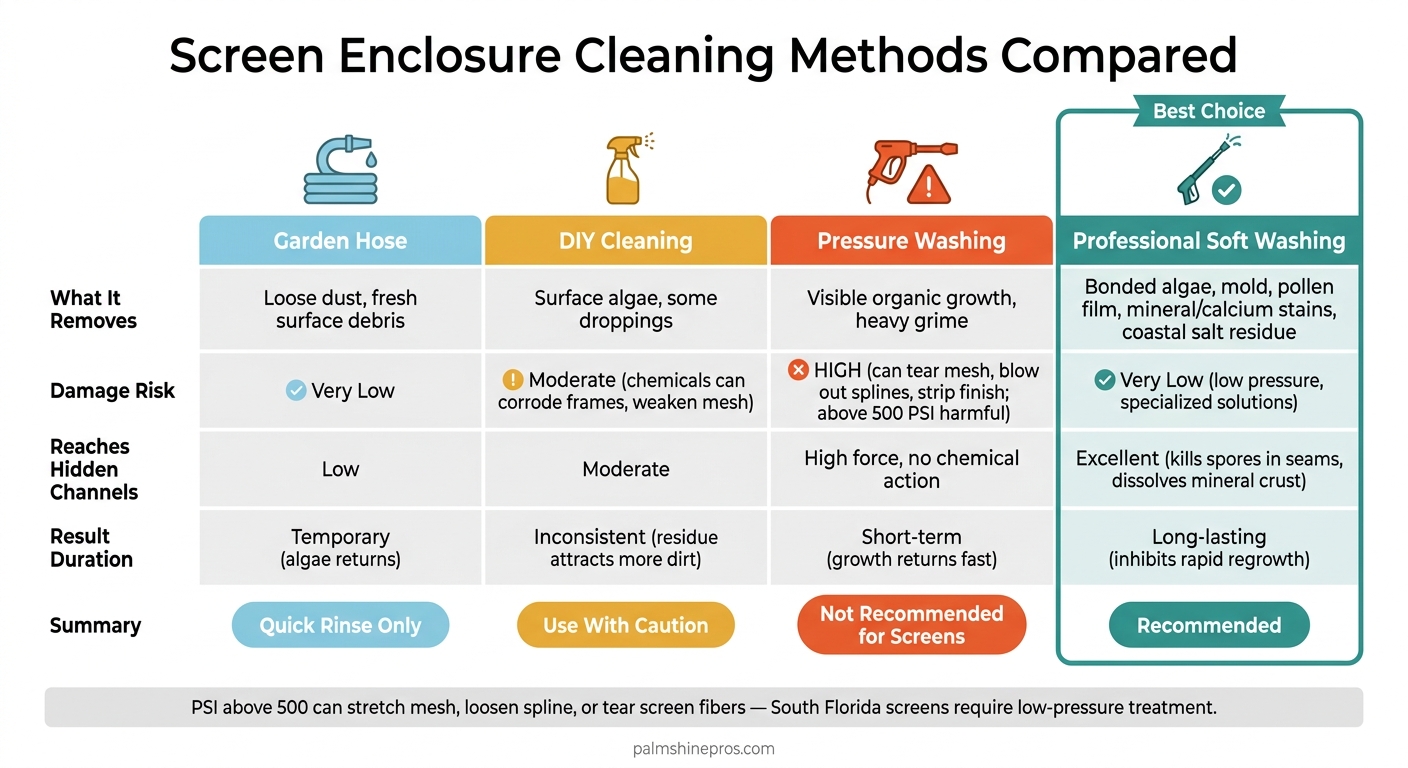
Screen Enclosure Cleaning Methods Compared: What Works in South Florida
A garden hose can wash away loose dust. But it can't break down algae, pollen film, bird droppings, or mold stuck in the mesh and frame channels. So the issue isn't just whether you rinse the enclosure. It's what can actually loosen that buildup without harming the screen.
What Rinsing Removes and What It Leaves Behind
A standard hose rinse helps with fresh pollen and light dust on the surface. That's the easy part.
What it doesn't do is reach recessed joints or dissolve irrigation scale. So the enclosure may look cleaner right after a rinse, while the grime is still sitting in the spots that matter most. In shaded channels, leftover moisture can also create the kind of damp conditions mold likes.
How DIY Cleaners and Pressure Can Damage Screens and Frames
DIY cleaning can cause problems too. Undiluted bleach and ammonia-based products may corrode aluminum frames, dull hardware, and weaken screen fibers.
Pressure is another risk. Anything above 500 PSI can harm residential screen panels by stretching the mesh, dislodging the spline, or tearing fibers that have already been weakened by sun exposure. For a broader look at where South Florida homeowners go wrong with exterior cleaning, this guide on exterior cleaning mistakes covers the most common missteps in detail. That's why the cleaning method matters just as much as the buildup itself.
Comparison Table: Garden Hose, DIY Cleaning, Pressure Washing, and Professional Soft Washing
Here's the practical difference between common methods and professional soft washing.
Method
Removes
Damage Risk
Works in Channels
Lasting Result
Garden Hose
Loose dust, fresh debris
Very low
Low
Temporary; algae returns from remaining spores
DIY Cleaning
Surface algae, some droppings
Moderate - chemicals can corrode frames and weaken mesh
Moderate
Inconsistent; residue attracts more dirt
Pressure Washing
Visible organic growth, heavy grime
High - can tear mesh, blow out splines, strip finish
Excellent - kills spores in seams, dissolves mineral crust
Long-lasting; inhibits rapid regrowth
Professional soft washing removes the bonded buildup that other methods leave behind, without the damage risks that come with high pressure or harsh cleaners.
sbb-itb-20350f7
What Professional Screen Enclosure Cleaning Removes
Professional soft washing removes the stuck-on buildup that collects on attached lanai and patio screen enclosures: algae, pollen film, bird droppings, calcium scale, and mold. Each one needs a different approach. Organic growth clings to the mesh, mineral scale builds up on lower frames, and mold hides in roofline channels.
How Soft Washing Clears Algae, Pollen Film, and Bird Droppings Without Damaging Mesh
Soft washing uses specialized solutions to loosen and kill organic buildup instead of blasting it off with force. That's a big deal for screen mesh, because high pressure can damage it fast.
When green algae is treated with soft washing, it's killed at the root. That helps the clean look last longer before regrowth shows up. A basic rinse doesn't do that. It leaves spores behind in the mesh weave.
Pollen is its own headache. It sticks to damp mesh and holds dust in the pores. Water by itself won't break that sticky film. Soft washing solutions break down the bond, then flush the debris out of the screen.
Bird droppings are acidic. After sitting in the South Florida sun, they can start breaking down the screen fibers underneath. Professional low-pressure cleaning lifts that waste safely, without harsh scrubbing that can tear delicate mesh.
Mineral stains and hidden mold need a different kind of chemistry, which is why those next two deposits matter.
How Specialized Treatment Handles Calcium Stains and Mold in Channels
White calcium deposits on lower aluminum frames don't come off with rinsing or household cleaners. This mineral scale forms when irrigation water dries up and leaves behind a hardened crust. Professionals use specialized treatments that break down calcium scale without etching the aluminum. Standard scrubbing usually can't do that without causing surface damage.
Mold in roofline channels is a separate problem. Those recessed areas stay damp long after rain, and brushes can't reach the seams and corners where spores take hold. Soft washing solutions move into those tight spaces and kill the mold in the seams instead of spreading it. For more on how mold behaves in South Florida's humidity and what it takes to control it, the mold-free living guide covers the conditions that keep it coming back.
The table below shows what each contaminant needs and why the method works:
Contaminant
Removal Method
Why It Works
Green Algae / Mold
Soft wash + dwell time
Kills spores at the root; prevents rapid regrowth
Pollen Film
Bio-enzymatic cleaners
Breaks the sticky film trapping dust in mesh pores
Calcium / Mineral Scale
Specialized treatments
Breaks down calcium scale without etching aluminum
Bird Droppings
Low-pressure soft washing
Lifts acidic waste without scrubbing or tearing mesh
What Homeowners Should Expect From Screen Enclosure Cleaning
Once the buildup is gone, most homeowners notice the change right away. Screens that looked cloudy start to look clear again. Lower frames lose that chalky staining, and roofline channels are cleaned out so trapped debris is no longer sitting there.
A clean enclosure can also make the lanai feel more open and easier to enjoy. Screens tend to hold onto pollen, algae, and mold spores. When that buildup gets heavy, the whole space can feel dirtier and less comfortable than it should. Washing that residue out of the mesh helps bring the area back.
If the buildup comes back fast, that usually points to the need for a seasonal cleaning schedule. Homes near the coast or under heavy tree cover often do well with service twice a year:
Spring to deal with pollen
Fall to clean up summer algae
Dark streaks on the mesh, green growth on north-facing panels, and white powdery residue on the lower frames are all signs that it’s time to book service instead of putting it off.
Professional soft washing uses low pressure, so it won’t stretch the mesh, loosen the spline, or strip the powder coating. For an estimate on attached lanai and patio screen enclosure cleaning, Palm Shine Pros can inspect the buildup and suggest a treatment plan.
FAQs
How often should I clean my screen enclosure in South Florida?
In South Florida, professional screen enclosure cleaning is usually best every three to six months. For most homes, twice a year is enough - ideally in spring to wash away pollen and again in fall to clear off summer grime.
Some homes need a bit more attention. If you're near the coast, have heavy tree cover, or your lanai stays in deep shade, buildup can show up faster. Sticking to this schedule helps stop grime from settling in and can help the aluminum framing and mesh last longer.
Will cleaning remove old stains completely?
Professional soft washing removes most old stains, including green algae, black mold, and mineral deposits, because it breaks down buildup that a garden hose just can't remove.
That said, cleaning has limits. It won't fix physical damage like corrosion or torn mesh. It can make a screen look much better, but areas that are damaged or badly worn may not come back all the way.
How do I know if my enclosure needs soft washing?
Consider professional soft washing when you can see buildup on the screens or frames. Common signs include green algae on screen panels, mold in frame channels, and white calcium or mineral deposits on lower aluminum frames. You may also notice a dull pollen film on south-facing panels or staining in shaded corners.
Because screens are delicate, soft washing removes these contaminants safely without tearing the mesh or blowing out the splines.
Lorem ipsum dolor sit amet, consectetur adipiscing elit, sed do eiusmod tempor incididunt ut labore et dolore magna aliqua. Ut enim ad minim veniam, quis nostrud exercitation ullamco laboris nisi ut aliquip ex ea commodo consequat. Duis aute irure dolor in reprehenderit in voluptate velit esse cillum dolore eu fugiat nulla pariatur.
.avif)

.avif)